
AI-Powered Network Security: Detecting Threats in Real Time
/A cyberattack no longer has to unfold slowly enough for a security analyst to catch it. What happens when an attacker—and the defense—can operate at machine speed?
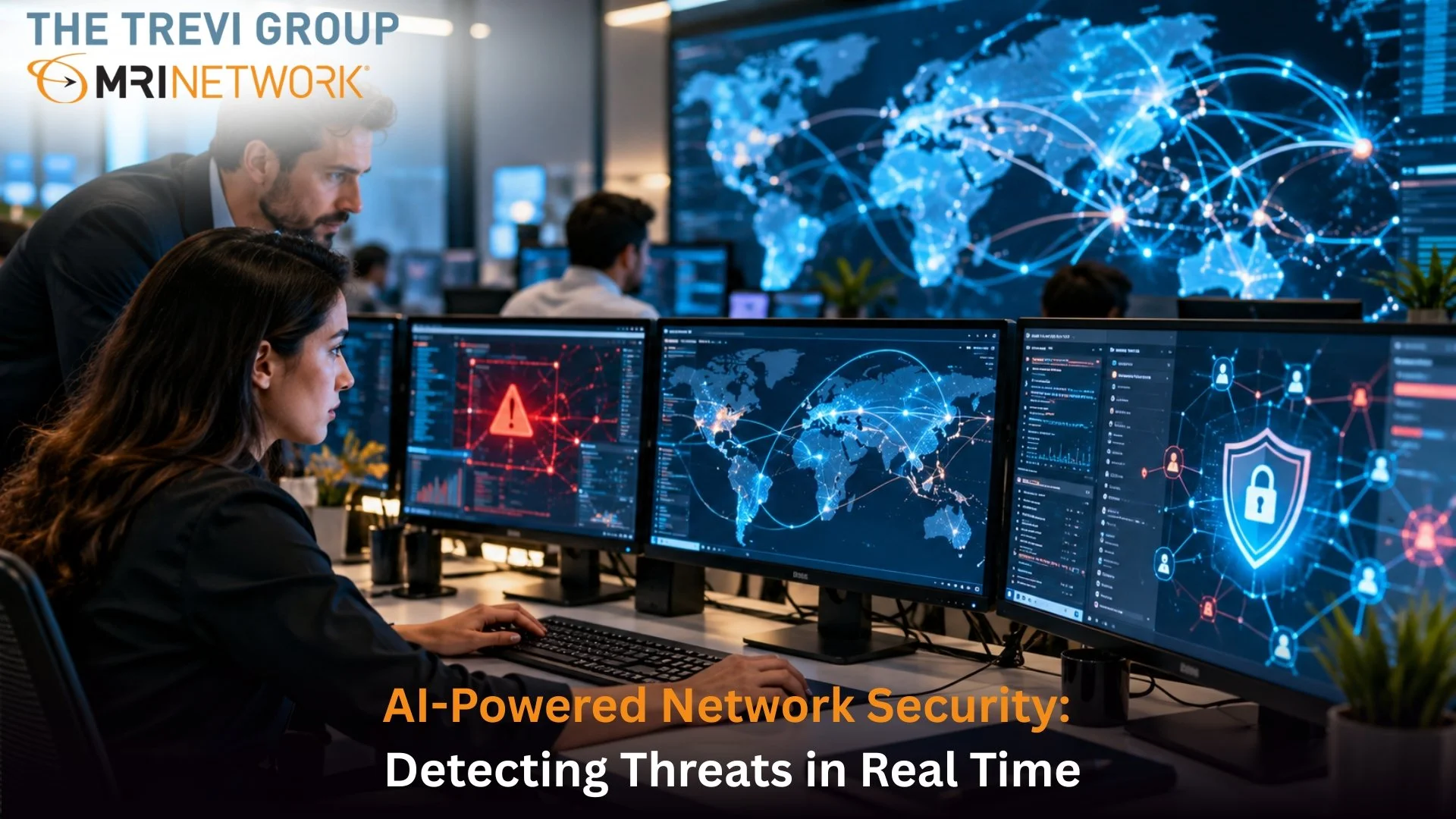
That question is becoming increasingly important as organizations connect more cloud services, applications, devices, and AI systems to their networks. Traditional security tools still matter, but enterprises are increasingly turning to artificial intelligence to identify suspicious behavior, connect seemingly unrelated signals, and accelerate response.
The Network Is Generating More Signals Than Ever
Modern enterprise networks produce an enormous amount of security data. A suspicious login, unusual data transfer, unexpected application behavior, or communication with a questionable endpoint may each look insignificant on its own.
AI can help connect those signals.
Instead of simply generating another alert, AI-powered security systems can analyze patterns across network traffic, endpoints, identities, cloud infrastructure, and applications to determine whether activity represents a genuine threat.
That shift is important because security teams cannot investigate every signal manually.
Real-Time Detection Is Becoming the New Standard
Recent developments from major cybersecurity companies show how quickly the industry is moving toward automated detection and response.
In September, CrowdStrike introduced Falcon Guardian, an AI Detection and Response capability designed to provide visibility and runtime enforcement for AI agents operating across enterprise environments. The company also announced coordinated, multi-agent investigations spanning endpoint, identity, SaaS, cloud, and network environments.
Cisco and Splunk are taking a similar approach. Their latest security developments focus on agentic security operations that can use enterprise telemetry to accelerate detection, investigation, and response while maintaining human oversight.
The objective is straightforward: find the threat earlier and understand its potential impact before it becomes a larger incident.
AI Is Changing the Attacker-Defender Equation
The urgency comes partly from the increasing use of AI by attackers.
Anthropic's September 2026 threat intelligence report documented multiple cases involving attempts to use Claude for malicious cyber activity, demonstrating how generative AI can increasingly become part of real-world cyber operations.
Palo Alto Networks has also warned that AI is compressing the time available to defenders. On September 22, the company introduced Unit 42 Continuous Frontier AI Defense, using multiple advanced AI models to continuously identify, validate, and help remediate enterprise exposures.
This creates a fundamental change in cybersecurity: defenders increasingly need automated systems capable of recognizing and responding to threats before a human-led process can complete every step.
But Automation Does Not Remove Human Judgment
Real-time security does not mean allowing AI to make every decision independently.
AI can identify patterns, investigate evidence, prioritize incidents, and recommend actions. Security professionals still need to determine whether an action is appropriate, particularly when it could disrupt critical systems or business operations.
That makes governance just as important as detection.
Organizations deploying AI-powered network security should consider:
Continuous monitoring across network, cloud, endpoint, and identity environments
Strong access controls for AI systems and agents
Clear rules for automated response
Audit trails for AI-generated decisions
Regular testing against new attack techniques
Human review for high-impact security actions
The Talent Behind the Technology
For IT leaders and hiring managers, AI-powered security is also creating a talent challenge.
Organizations need professionals who understand more than traditional network security. Increasingly, valuable expertise sits at the intersection of network engineering, cloud security, AI, automation, identity, threat intelligence, and security operations.
The role of the security professional is changing from manually reviewing every alert toward interpreting complex signals, managing automated systems, investigating sophisticated attacks, and making high-impact decisions.
That makes specialized cybersecurity talent an increasingly important part of an organization's AI strategy.
The Bigger Picture
AI-powered network security is not simply about making security tools faster. It represents a broader change in how enterprises defend their digital environments.
As attackers use AI to operate faster and more adaptively, organizations will need defenses capable of doing the same—without sacrificing accountability or human judgment.
The question for technology leaders is no longer simply whether AI belongs in the security stack.
The more important question is: How much of your network security can safely operate at machine speed, and where should human expertise remain firmly in control? Interested to get your opinion.
The Trevi Group | “Executive Search for Technology Professionals” | www.TheTreviGroup.com
#thetrevigroup #recruitingtrends #informationtechnology #employmenttrends #jobmarket #hiringtrends