
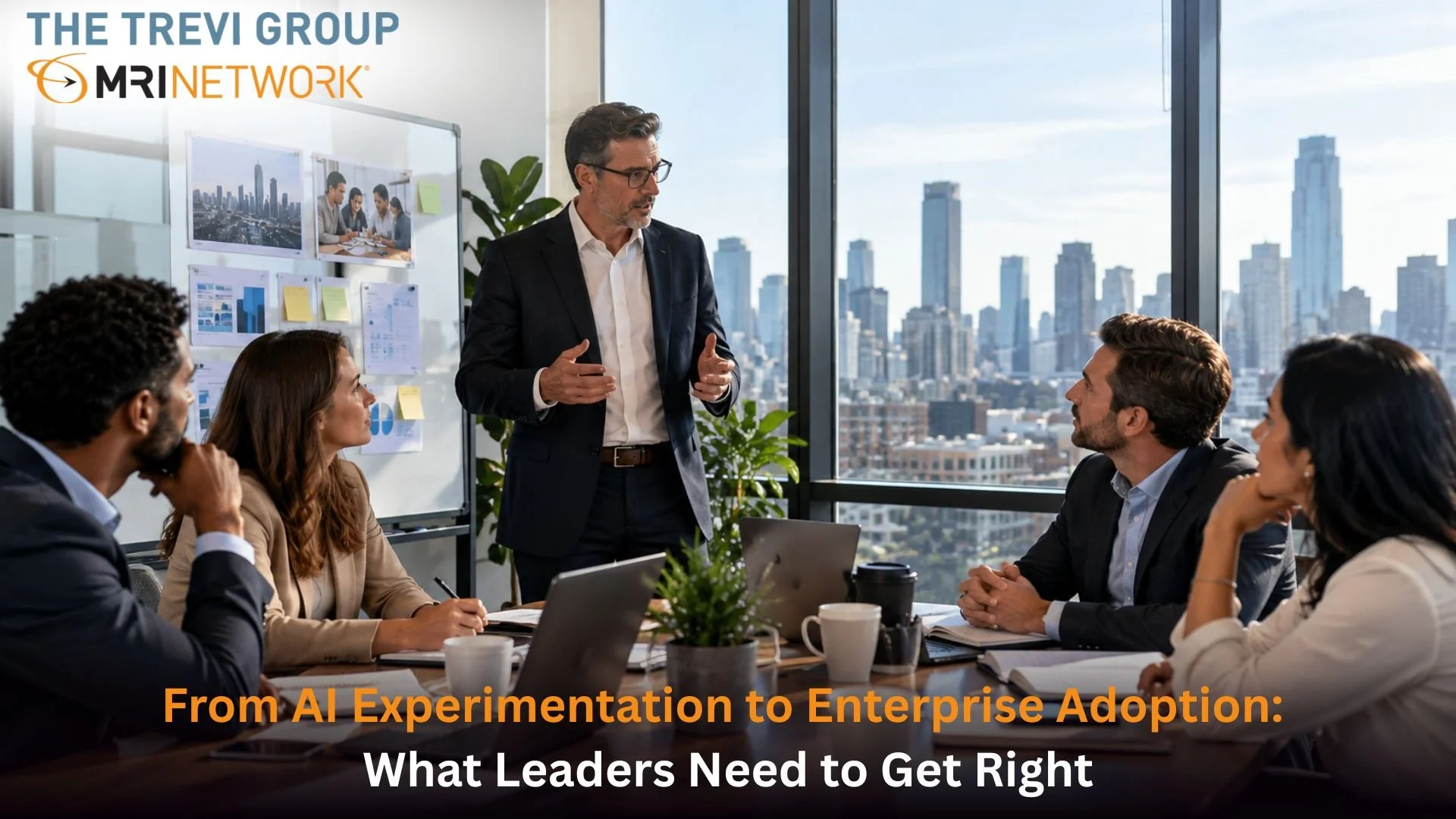
From AI Experimentation to Enterprise Adoption: What Leaders Need to Get Right
/
What happens when a company spends millions exploring artificial intelligence but struggles to turn those experiments into measurable business results? That is the challenge facing American businesses in 2026 and 2027: moving beyond AI excitement to real enterprise value.
The Real AI Race Is About Execution
Across the U.S., companies are moving beyond simple chatbots and testing AI in customer service, software development, financial analysis, recruiting, and daily operations. The next competitive advantage will not come from simply adopting the newest tool. It will come from integrating AI into the way people actually work.
Recent developments from major technology companies have reinforced this shift. Microsoft continues to embed AI into its productivity ecosystem, while Alphabet and Amazon are investing heavily in AI infrastructure and cloud services. These moves signal a broader business priority: making AI useful at scale, not just impressive in a demonstration.
For business leaders, the question is no longer whether AI deserves attention. It is where AI can deliver meaningful results.
Start With Business Problems, Not Technology
One common mistake is launching AI projects without defining what success looks like. A promising pilot can quickly become an expensive distraction when nobody knows how to measure its impact.
Before expanding an AI initiative, leaders should ask:
What problem are we solving? Target a specific bottleneck, customer frustration, or repetitive task.
How will we measure success? Track outcomes such as processing time, operating costs, customer satisfaction, or revenue growth.
Can the solution scale? Consider integration with existing systems, data quality, security, and ongoing costs.
A small, successful deployment with clear financial benefits can be more valuable than dozens of disconnected experiments.
People Will Determine the Payoff
Technology alone cannot deliver transformation. Employees need training, managers need realistic expectations, and teams need clarity about when human judgment must take priority.
Recruiters and hiring managers also play a role. As AI changes job responsibilities, organizations need people who combine technical understanding with communication, critical thinking, and sound decision-making.
Rather than hiring exclusively for AI expertise, companies should identify where existing employees can become more effective with the right tools and training.
Investors Are Watching the Economics
The stock market's enthusiasm for AI has made infrastructure spending, cloud growth, and technology earnings important indicators for investors. But spending announcements alone don't prove a company is building a sustainable advantage.
Investors should look beyond AI headlines and examine revenue growth, operating margins, capital expenditures, and evidence that customers are paying for AI-powered services.
For executives, the same principle applies: adoption matters only when it creates measurable value without introducing unacceptable risks.
The Next Competitive Advantage
Successful enterprise AI adoption requires a clear strategy, reliable data, responsible governance, and employees who know how to use the technology effectively. The winners will be organizations that connect innovation directly to business outcomes.
AI experimentation creates possibilities. Disciplined execution creates value.
What do you think is the biggest barrier to enterprise AI adoption today: cost, employee readiness, data quality, or leadership strategy? Share your perspective.
The Trevi Group | “Executive Search for Technology Professionals” | www.TheTreviGroup.com
#thetrevigroup #recruitingtrends #informationtechnology #employmenttrends #jobmarket #hiringtrends