Interviewing Tips (questions to ask, and questions you may be asked)

Before you interview for a position, learn as much about it and the employer as possible. If you found the position through a recruiter, he or she should be able to provide that information for you. If not, conduct research on the Web, visit the library, and tap into industry contacts.

Questions To Ask

After you have studied the company, make a list of questions to ask the employer:

  • What are the company's plans for future growth?

  • Looking out one year, what will be the measures of success?

  • What are the biggest challenges?

  • How would you describe your management style?

  • What are the most critical issues to address in the first 30/60/90 days?

  • How would you describe the company's culture?

  • Ask about the organization and the team.

  • Are there certain employees who might be resources to me?

  • What are the qualities you are looking for in the candidate for this position?

  • Why is this position available?

  • What training programs are available to the person in this position?

  • What are your goals for this position?

  • What obstacles must be overcome for the person in this position to succeed?

  • How will my performance be evaluated?

  • What opportunities are there for growth in the next 12 months? Two years? Five years?

  • What growth do you anticipate for your organization in the next 12 months?

  • Is there anything else you would like to know about me?

  • What are the next steps in the selection process?

  • Push a little to understand if there are any objections to proceeding to the next step. Perhaps you need to clarify a thing or two.

Questions You May Be Asked

Your recruiter should be able to give you a good idea of the hiring manager's personality, his or her typical interview demeanor, and a few important questions that the employer is likely to ask, such as:

  • Tell me about yourself.
    Keep your answer in the professional realm only. Review your past positions, education and other strengths. This is usually an ice-breaker question. Keep it crisp… ideally one minute or less.

  • Why are you interested in this position?
    Relate how you feel your qualifications match the job requirements. Also, express your desire to work for the employer.

  • What are the most significant accomplishments in your career?
    Identify recent accomplishments that relate to the position and its requirements.

  • Describe a situation in which your work was criticized.
    Focus on how you resolved the situation and became a better person because of the experience.

  • What do you know about our organization?

  • How would you describe your personality?

  • How do you perform under pressure?

  • What have you done to improve yourself over the past year?

  • What did you like least about your last position?

  • Are you leaving (did you leave) your present (last) company?

  • What is your ideal working environment?

  • How would your co-workers describe you?

  • What do you think of your boss?

  • Have you ever fired anyone?

  • What was the situation and how did you handle it?

  • Are you creative?

  • What are your goals in your career?

  • Where do you see yourself in two years?

  • Why should we hire you?

  • What kind of salary are you looking for?

  • What other types of jobs/companies are you considering?

>> Return to Job Search Tools

The Trevi Group | “Executive Search for Technology Professionals” | www.TheTreviGroup.com

#thetrevigroup #careerdevelopment @careeradvice #interviewtips

Forbes Recognizes MRINetwork for Sixth Year in a Row

Forbes.com, one of the world’s most respected sources of business information, has once again recognized MRINetwork in their annual “America’s Best Recruiting and Temp Staffing Firms 2022” research program.

Over 22,400 different recruitment industry firms were nominated by almost 40,000 client and candidate respondents in the 2022 survey. Once again MRINetwork was recognized among the elite top 1% in both the Executive Search and Professional and Specialist Search categories.

We are proud to receive this designation for the sixth consecutive year on behalf of the entire Network.

The Trevi Group | “Executive Search for Technology Professionals” | www.TheTreviGroup.com

Employment Summary for April 2022 (BLS Report)

Despite rising interest rates, fears of an economic slowdown, and geopolitical turmoil, the U.S. Bureau of Labor Statistics (BLS) reported the economy added 428,000 jobs in April.

Unemployment remained unchanged at 3.6 percent. Among the college-educated civilian workforce, the primary target of the MRINetwork’s recruitment efforts, the unemployment rate remained at 2.0 percent pointing to a continued constrained labor market.

The number of job openings rose to 11.5 million by the end of March — indicating there are close to two open jobs for every unemployed person.

The number of employed persons reporting they had worked remotely at some point in March declined again to 7.7 percent as COVID-19 restrictions were lifted throughout the country and changes in employer policies increased on-site activity.

“Over 420 of our MRINetwork’s best recruitment professionals and talent advisors will meet in Fort Worth, Texas next week. With a theme of ‘Build-Learn-Connect-Engage,’ we will deliver incredible usable content in a unique learning environment to amplify and elevate our recruitment and talent consulting skillsets.

I mention this in context of today’s BLS Employment Situation Report to make a point. Regardless of any single data report, like today’s April employment growth of over 400,000 jobs, both growing talent-hungry firms and talented executive, technical, managerial and professional performers need to focus on building teams and leadership skillsets to drive future growth,” said Bert Miller, President, and CEO of MRI, one of the world’s leading search and recruitment organizations.

“A critical component of building organizations and individual careers is overcoming self-limiting fears. I have seen smart managers seemingly hit a ceiling once they have achieved a significant milestone like a successful product launch or earning a big promotion. At this point many allow a self-limiting mindset to hold themselves back and leave much future capacity and capability on the table.

Challenge yourself and your organization to constantly dream big. Peel back any fear or self-limiting mindset and don’t get comfortable with today’s success while pressing forward to take on the next goal.”

Mark Zandi, chief economist at Moody’s Analytics, provided a longer-term view of this month’s results, “The labor market continues to barrel along. We need it, at this point in time, to slow down a bit because we’re going to blow past full employment and inflation is going to become a bigger problem than it already is. Ultimately, we need to get to something that’s closer to no more than 100,000 a month.”

Noting that this is the 12th straight month of job gains above 400,000, though easing from a February gain of 750,000 jobs, Wall Street Journal reporter Josh Mitchell commented, “The labor market’s latest issue has been on the supply side, with an unusually tight pool of workers available to fill jobs, a dynamic that has fueled record wage growth and put pressure on rising inflation. In March there were just under six million unemployed people seeking work.” In the same article Kathy Bostjancic, chief U.S. economist at Oxford Economics added, “Anecdotally companies are still saying the biggest issue is a lack of available workers.”

Job gains in April were broad-based with moderate increases in most segments.

Employment in leisure and hospitality increased by 78,000 in April. Job growth continued in food services and drinking places (+44,000) and accommodation (+22,000).

Manufacturing added 55,000 jobs in April. Employment in durable goods rose by 31,000, with gains in transportation equipment (+14,000) and machinery (+7,000). This sector has recovered virtually all jobs lost since February 2020.

Employment in transportation and warehousing rose by 52,000 in April. Within the industry, job gains occurred in warehousing and storage (+17,000), couriers and messengers (+15,000), truck transportation (+13,000), and air transportation (+4,000). Employment in transportation and warehousing is 674,000 above its February 2020 level, led by strong growth in warehousing and storage (+467,000) and in couriers and messengers (+259,000).

In April, employment in professional and business services continued to trend up (+41,000). Since February 2020, employment in the industry is up by 738,000.

Financial activities added 35,000 jobs in April, led by a gain in insurance carriers and related activities (+20,000).

In other sectors, healthcare employment rose by 34,000 in April, employment in retail trade increased by 29,000, wholesale trade employment rose by 22,000, and mining added 9,000 jobs.

“Talented performers open their eyes wider than they thought possible — remove any blinders and seek a view that seems far away and yet, is within reach.

They are curious and intentional about learning and recognize where obtaining new skills and up-skilling will provide a clear career advantage.

None of us are what we can become. Eyes open and keep looking and working to see who you can become — you might just find yourself in place that you had never dreamed,” noted Miller.

The Trevi Group | “Executive Search for Technology Professionals” | www.TheTreviGroup.com

‘SHIFT Report (May): Trending Topics in the World of Work_

Our May issue of SHIFT explores demystifying the metaverse, top hiring trends, taking diversity and inclusion seriously, and the future of work.

What Business Leaders Need to Know about the Metaverse

A comprehensive overview, based on research by PwC, focuses on demystifying the metaverse, which has the potential to change how businesses and consumers interact with products, services and each other. The metaverse promises a stunningly realistic 3D digital world where you can, for example, purchase and sell goods and services, sign and enforce contracts, recruit and train talent, and interact with customers and communities.

Jump to Article > >


Top Hiring Trends Emerging in 2022

Changing technologies and new ways of working are dramatically shaping the way businesses source and hire talent, and the pandemic has only accelerated this dynamism. To address critical skills needs, recruitment professionals need to stay on top of seven key hiring trends — none of which are going away soon.

Jump to Article > >


Taking Diversity and Inclusion Seriously in the Workplace

Many businesses are making the creation of a diverse and inclusive company culture a priority today, but are finding it challenging to move the needle. But if you get it right, the rewards are impressive and well worth the effort. According to an article in Foundr Magazine, half the battle is recognizing the problem, committing to a goal, creating a plan of action, and executing to the best of your abilities. Diversity and inclusion, the author maintains, aren't so much end goals as they are a constant transformation.

Jump to Article > >


The Working Future

A year of in-depth research conducted by Bain & Company focuses on defining the broader implications of the future of work and the steps firms need to take now to get ahead in the shifting war for talent. It is based on a survey of 20,000 workers from ten countries — the United States, Germany, France, Italy, Japan, China, India, Brazil, Indonesia and Nigeria — that represent around 65% of global GDP. According to the report, business leaders trying to stay ahead in increasingly competitive markets will pivot from being talent takers to talent makers, which requires scaling investments in learning and cultivating a growth mindset in their organization.

Jump to Article > >


The Trevi Group | “Executive Search for Technology Professionals” | www.TheTreviGroup.com

'SHIFT Report (April) - Trending Topics in the World of Work_

Our April issue of SHIFT explores investing in your workforce, the power of transportable skills, the importance of employee retention, and the reinvention of company culture.

Investing in Workforce a Top Priority for 2022

The latest PwC Pulse Survey, fielded January 10 to January 14, 2022, surveyed 94 human resource leaders from Fortune 1000 and private companies, along with other C-suite executives, about business priorities, investment plans and other concerns. The report based on the survey indicates that HR leaders know that it's people who move business forward, and 61% of HR respondents say hiring and retaining talent will be a key investment for their companies in 2022. That's also the top investment area cited among all executives in the survey. As HR executives are increasingly elevated to a seat at the strategy table, other leaders are looking to them to drive this agenda.

Jump to Article > >


The Power of Transportable Skills

All workers will need to adapt and learn new skills over their careers, but some skills stand the test of time. Because workers can use these skills to navigate transitions across virtually any industry, these "transportable skills" have lifelong value. In a recent report, "The Power of Transportable Skills: Assessing the Demand and Value of the Skills of the Future," Project Lead The Way (PLTW) and Burning Glass Technologies examined workforce demand for five such skills: collaboration, problem-solving, critical and creative thinking, communication, and ethical reasoning and mindset.

Jump to Article > >


The Importance of Employee Retention

An article from the Wharton School at the University of Pennsylvania emphasizes the importance of employee retention and how you can improve it at your company by investing in your team to combat attrition. Citing a study from the Society for Human Resource Management (SHRM), the article points out that employee turnover is expensive, costing an average of 6 to 9 months' salary to replace a worker. Employee engagement is one of the top turnover causes, and businesses that focus on improving employee engagement, not just revenue, can see benefits throughout their company and operations. Suggestions for strengthening your workforce, improving employee engagement and decreasing turnover include offering flexible work options, providing learning and development opportunities, and supporting work-life balance.

Jump to Article > >


The Reinvention of Company Culture

Company culture is having a watershed moment. It is being reshaped in a crucible by the pandemic, the acceleration of automation, the rise of millennials and Gen Z in the workforce and the Great Reshuffle. The human-centered company culture being forged has some recurring characteristics: flexibility, asynchrony, trust, belonging, and a holistic focus on well-being. Gone are the days when companies could lead with perks — think ping-pong tables and endless snacks — designed to make the office a home away from home. Today, forward-thinking organizations are working with employees to make home an office away from office.

Jump to Article > >


The Trevi Group | “Executive Search for Technology Professionals” | www.TheTreviGroup.com

Employment Summary for March 2022 (from BLS Report)

Meeting analysts’ expectations, the U.S. Bureau of Labor Statistics (BLS) reported the economy added 431,000 jobs in March. Unemployment continued to decline, now reported at 3.6 percent. Among the college-educated civilian workforce the unemployment rate was 2.0 percent indicating a continued tight labor market.  The labor-force participation rate among the college-educated cohort rose to 72.8 percent. Today’s Wall Street Journal noted that household savings are declining, which is likely pressuring some individuals to rejoin the labor force to collect a paycheck, especially as prices rise briskly for gasoline, groceries and rent, perhaps adding to the full employment picture.

Teleworking declined again in March to 10.0 percent versus 13.0 percent in February as easing COVID-19 restrictions and changes in employer policies brought more people back to the workplace.

“The March BLS employment growth report comes as no surprise to our Network of over 1500 executive recruiters in offices throughout the U.S. Despite economic headwinds, the specter of growing inflation and geopolitical uncertainty we continue to see robust demand for talent in our clients’ organizations in every sector of the economy,” said Bert Miller, President, and CEO of MRI one of the world’s leading search and recruitment organizations.

“I have been immersed in the world of talent for 37 years; ten in corporate America and the last 27 in recruiting. Through recessions, periods of slow steady growth, and in rapid expansion cycles there has been one reoccurring challenge to talented performers in even top organizations.  Individuals tend to get ‘comfortable’ — they stop intentional learning.

We coach talented executives, managers, professionals, and even technical-based workers to look past current economic conditions and to avoid complacency — to keep their eyes open to who they can become. Complacency in any position leads to mediocrity and mediocrity leads to missed business opportunities and to fewer career options.

Our advice is simple. Be intentional, disciplined and never lose that curiosity to learn. Find who you can be without limitations. Top talent, at any career level, knows they could get that promotion, work with a dream organization, or even run a company.”

“All the constraints on the labor supply that were prevailing in 2021 have really eased,” said Lydia Boussour, economist at Oxford Economics. That is “a really important factor in driving that next leg of the recovery and getting employment back to where it was before the pandemic.”

Commenting on the overall health of the employment market despite the headwinds, Jefferies Group analysts Aneta Markowska and Thomas Simons noted, "It's premature to start the recession countdown. This does not look like a late-cycle economy ... It's a mid-cycle economy and the business cycle has room to run."

Employment in leisure and hospitality continued to increase, with a gain of 112,000 in March. Job growth occurred in food services and drinking places (+61,000) and accommodation (+25,000). Employment in leisure and hospitality continues to recover from its steep decline and is now down by only 8.7 percent, since February 2020.

Job growth continued in professional and business services, which added 102,000 jobs in March. Employment in this sector is now 723,000 higher than in February 2020.

Employment in retail trade increased by 49,000 in March, with gains in general merchandise stores (+20,000) and food and beverage stores (+18,000).

Manufacturing added 38,000 jobs in March. Employment in durable goods industries rose by 22,000. Nondurable goods manufacturing added 16,000 jobs over the month, including a gain in chemicals (+7,000).

Employment in construction continued to trend up in March (+19,000). Also in March, employment in financial activities rose by 16,000, with gains in real estate and rental and leasing (+14,000). Employment in both of these industry segments is now at or above pre-pandemic levels.

Employment in healthcare and in transportation and warehousing was essentially unchanged in March following large gains in these sectors in the prior 2 months.

“Talented performers open their eyes wider than they thought possible — remove any blinders and seek a view that seems far away and yet, is within reach.

They are curious and intentional about learning and recognize where obtaining new skills and up-skilling will provide a clear career advantage.

None of us are what we can become. Eyes open and keep looking and working to see who you can become — you might just find yourself in place that you had never dreamed,” noted Miller.

The Trevi Group | “Executive Search for Technology Professionals” | www.TheTreviGroup.com

'SHIFT Report (March) - Trending Topics in the World of Work_

Our March issue of SHIFT explores trends that will shape workplace volatility in 2022, pressing issues that face CEOs today, how organizations are evolving to the next stage of the digital economy, and the future of work beyond the job.


Trends that Will Shape Work in 2022 and Beyond

We've been living through the greatest workplace disruption in generations and, according to an article in the Harvard Business Review, the level of volatility will not slow down in 2022. HBR identifies 11 underlying trends that will shape workplace volatility in 2022.

Jump to Article > >


PwC's 25th Annual Global CEO Survey

As the global economy continues to rebound from the depths of mid-2020, the 4,446 CEOs from 89 countries and territories who responded to PwC's 25th Annual Global CEO Survey display optimism about continued economic resilience, with 77% indicating that they expect global economic growth to improve during the year ahead, the highest figure on record since 2012, when PwC first began asking CEOs how they felt about the economy's potential. The survey delves into the pressing issues facing CEOs today and underscores just how full their "inboxes" have become.

Jump to Article > >


The Work Ahead: Digital First (to Last)

The Work Ahead is a research series providing insight and guidance on how organizations are evolving to the next stage of the digital economy. With the rise of new machines, new generations of talent and new business models based on insight and intelligence, the rules of global competition have changed. Now, these tectonic shifts are being further catalyzed and accelerated by the global pandemic. This comprehensive report outlines the most significant trends and tactics for businesses throughout the world to be aware of, and act on, to ensure a successful future for the future of work.

Jump to Article > >


Beyond the Job

Researchers at Deloitte are also considering the future of work and pose the following question: How do we go about organizing work beyond the constraints of the traditional job in a way that unleashes the potential of both organizations and people at scale and speed?

Jump to Article > >

The Trevi Group | “Executive Search for Technology Professionals” | www.TheTreviGroup.com

Employment Summary for February 2022

The U.S. Bureau of Labor Statistics (BLS) reported the economy added a robust 678,000 jobs in February as the unemployment rate edged down to 3.8 percent. Job growth was widespread, with notable gains in leisure and hospitality, professional and business services, healthcare, and construction. Among college-educated civilian workers, the unemployment rate declined slightly to 2.2% — near record lows.

Teleworking declined in February from January’s high of 15.4 percent to 13.0 percent as the labor force responded to easing COVID-19 restrictions.

“February’s BLS report continues to chart an ongoing jobs recovery since March 2020. More importantly it measures growth in skilled jobs as unemployment among college educated workers points to virtually full employment. The Chicago Fed’s February Letter has an interesting analysis that aligns with many of our executive recruitment team’s observations about the new world of work emerging as the COVID-19 threat fades and the economy continues to grow. Essentially the report concludes that millions of skilled workers quickly took the first job available in the months following the March 2020 COVID-19 plunge. Many of those new positions did not align with the job seekers skills, purpose nor did they find a compelling cultural match. These people as well as the thousands of executive, technical, professional, and managerial workers who were not impacted by layoffs see this recovery period as an opportunity to make a positive career change,” said Bert Miller, President and CEO of MRI.

“Some talent industry analysts have asked, 'why is so much of the workforce unhappy?' as if unhappiness was driving much of this job churn. Based on what our Network of over 1500 professional recruiters observes and what I see in the market, it is not unhappiness. It is a workforce that is not finding career fulfillment.

We spend a great deal of time at work. In many ways, our job defines what we are, how secure we feel, and to a certain extent, if we're able to actualize our dreams. When you're stuck in a job with no advancement potential, little stability, and earnings that don't reflect what you're worth, it's not a good place to be. When those priorities are met, people are more fulfilled.

It really comes down to building an attractive workplace culture through values — focusing on the things that are important to the top performers. We counsel our clients to focus on a strong hiring and individual brand, culture and core values.”

Jay Timmons, president and CEO of the National Association of Manufacturing noted a key factor in providing workers with a sense of fulfillment is a push to provide paths to ‘upskilling.’ "There’s hardly ever been more opportunities for future manufacturing workers. Innovators. Designers. Technicians. Creators," he commented. "To help workers advance in their careers, companies are investing in upskilling programs — so that people can keep improving their skills as technology advances throughout their careers.”

Wall Street Journal reporter Josh Mitchell provided context to the need for employers to create a more attractive workplace, “While virus infections have fallen sharply since their peak in mid-January, employers say they continue to struggle to find workers as they respond to a high level of spending from households. Though some workers have come off the sidelines in recent months, the labor force remains depleted, with many older workers having retired, immigration down sharply and some younger and middle-aged workers remaining at home.”

Employment in leisure and hospitality continued to increase, with a gain of 179,000 in February. Job growth occurred in food services and drinking places (+124,000) and in accommodation (+28,000). While continuing a robust trend in job creation, employment in this sector remains 1.5 million lower than in February 2020.

Professional and business services added 95,000 jobs in February, with job gains in virtually every sector including management of companies and enterprises (+12,000) and management and technical consulting services (+10,000). Employment in professional and business services is 596,000 higher than in February 2020.

Employment in healthcare rose by 64,000 and in construction by 60,000 in February.

Transportation and warehousing employment increased by 48,000 in February and is 584,000 higher than in February 2020.

In other industries, February employment rose by 37,000 in retail trade, 36,000 in manufacturing, and 35,000 in financial activities.

“People gravitate towards values-focused organizations, firms that offer flexibility, with leaders and team members who they enjoy working with every day. Talented workers want to work with firms that have compelling clearly stated purpose and values, enlightened leadership and yes, competitive compensation. These factors drive not only loyalty, but they also create an environment that drives true career fulfillment,” noted Miller.

The Trevi Group | “Executive Search for Technology Professionals” | www.TheTreviGroup.com

BLS Report: Employment Summary for January 2022

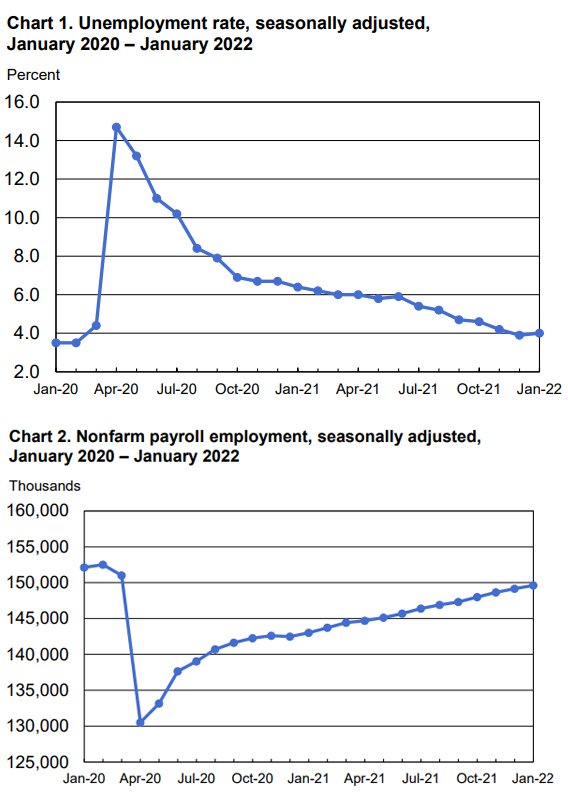
Total non-farm payroll employment rose by 467,00 in January, well above analyst’s estimates that had factored in a significant impact for the COVID-19 Omicron variant. Today’s U.S. Bureau of Labor Statistics (BLS) report also noted the unemployment rate edged higher to 4.0 percent. The unemployment rate for college-educated members of the civilian workforce increased slightly to 2.3 percent but still at a level indicating near full employment in this demographic.

Notable job gains occurred in multiple sectors, with the highest increase in leisure and hospitality.

The labor force participation rate data increased slightly to 62.2 percent but remained below the pre-pandemic level of 63.4 percent.

The percent of non-farm workers reporting that they teleworked at some point in the past four weeks jumped to 15.4 percent versus 11.1 percent in December 2021. The increase might be due to short-term effects of the jump in Omicron infections throughout January.

“January’s BLS report tells a short-term story about the effects of the Omicron surge as an estimated 9 million workers called in sick in early January and employee work-from-home rates increased. These factors clouded the jobs data forecasts. In our most recently reported month, December 2021, our MRINetwork of over 300 search firms and more than 1,500 recruitment professionals saw through the clouds. Network revenue from search assignments increased 25% versus the previous December. Our view is underlying demand for executive, technical, professional and managerial talent remains strong,” said Bert Miller, President and CEO of MRI. “I’ve been in the executive recruitment business for over 27 years and have seen economic cycles drive peaks and valleys in hiring demand. What I haven’t seen is top performing firms easing up on the hiring throttle as they continue to build best-in-class leadership, sales, marketing, and operations teams. Talented individuals are in demand today and will continue to be in demand through virtually any business cycle. That’s why we continue to help our clients to build and effectively communicate their hiring brand, culture, and core values to attract the best talent.”

Wall Street Journal reporters Sarah Chaney Cambon and Gabriel T. Rubin observed, “Many workers are reaping their largest pay gains in years, as companies compete for a limited pool of workers. Wage growth — at nearly 5% — is much stronger than the average of about 3% before the pandemic hit. They also quoted Luke Tilley’s, chief economist at Wilmington Trust Investment Advisors, observation that ‘The labor market is as tight as we have ever seen it.’

Goldman Sachs economist Spencer Hill noted that people who reported they couldn’t work because their employer closed or lost business due to the surge were likely offset by fewer-than-normal year-end layoffs as many companies were hesitant to let workers go amid widespread labor shortages.

Employment in leisure and hospitality expanded by 151,000 in January, reflecting job gains in food services and drinking places (+108,000) and in the accommodation industry (+23,000). This industry was among the hardest hit since the onset of the virus. Employment in leisure and hospitality is down by 1.8 million, or 10.3 percent since February 2020.

In January, professional and business services added 86,000 jobs across multiple segments. Job gains occurred in management and technical consulting services (+16,000), computer systems design and related services (+15,000), architectural and engineering services (+8,000), and other professional and technical services (+7,000). Employment in this industry is 511,000 higher than in February 2020.

Retail trade employment rose by 61,000 in January. Most of the job growth occurred in general merchandise stores (+29,000); health and personal care stores (+11,000).
Employment in transportation and warehousing increased by 54,000 in January and is 542,000 higher than in February 2020. In January, job gains occurred in couriers and messengers (+21,000), warehousing and storage (+13,000), truck transportation (+8,000), and air transportation (+7,000).

Employment in healthcare and wholesale trade continued to trend up +18,000 and + 16,000 respectively. Employment showed little change over the month in mining, construction, manufacturing, information, financial activities, and other services.

“At our recent MRINetwork leadership conference I repeated Nelson Mandela’s sage advice, ‘There is no passion to be found playing small — in settling for a life that is less than the one you are capable of living.’ Our advice to talented professionals both starting their careers and with decades of experience reflects that sentiment. The key factor differentiating why some candidates go on to run companies and live the life they want personally, professionally, and financially is overcoming self-limitation. Individuals have more control over their careers today than perhaps ever. We urge people to think big — think infinite and to be courageous enough to maximize and live the life you are capable.

“It’s clear from my vantage point that those who never limit themselves or play small are the people today’s leading companies will target. My best advice for any manager or professional ... Do not play small and Do not settle. If you do, you will limit yourself and be less than you are capable. Think big, be humble, tirelessly work on your game and be courageous,” noted Miller.

The full Bureau of Labor Statistics report can be downloaded here

The Trevi Group | “Executive Search for Technology Professionals” | www.TheTreviGroup.com