
BLS Report: Employment Summary for January 2022

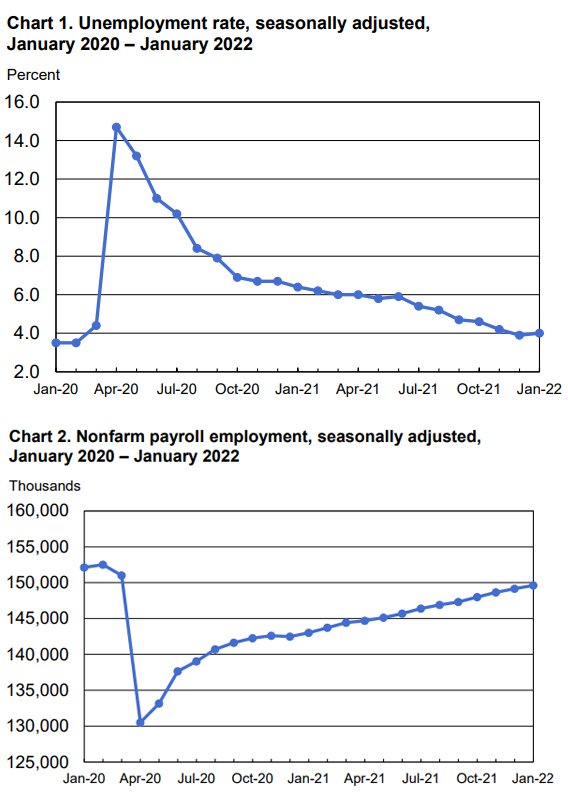
Total non-farm payroll employment rose by 467,00 in January, well above analyst’s estimates that had factored in a significant impact for the COVID-19 Omicron variant. Today’s U.S. Bureau of Labor Statistics (BLS) report also noted the unemployment rate edged higher to 4.0 percent. The unemployment rate for college-educated members of the civilian workforce increased slightly to 2.3 percent but still at a level indicating near full employment in this demographic.

Notable job gains occurred in multiple sectors, with the highest increase in leisure and hospitality.

The labor force participation rate data increased slightly to 62.2 percent but remained below the pre-pandemic level of 63.4 percent.
The percent of non-farm workers reporting that they teleworked at some point in the past four weeks jumped to 15.4 percent versus 11.1 percent in December 2021. The increase might be due to short-term effects of the jump in Omicron infections throughout January.

“January’s BLS report tells a short-term story about the effects of the Omicron surge as an estimated 9 million workers called in sick in early January and employee work-from-home rates increased. These factors clouded the jobs data forecasts. In our most recently reported month, December 2021, our MRINetwork of over 300 search firms and more than 1,500 recruitment professionals saw through the clouds. Network revenue from search assignments increased 25% versus the previous December. Our view is underlying demand for executive, technical, professional and managerial talent remains strong,” said Bert Miller, President and CEO of MRI. “I’ve been in the executive recruitment business for over 27 years and have seen economic cycles drive peaks and valleys in hiring demand. What I haven’t seen is top performing firms easing up on the hiring throttle as they continue to build best-in-class leadership, sales, marketing, and operations teams. Talented individuals are in demand today and will continue to be in demand through virtually any business cycle. That’s why we continue to help our clients to build and effectively communicate their hiring brand, culture, and core values to attract the best talent.”

Wall Street Journal reporters Sarah Chaney Cambon and Gabriel T. Rubin observed, “Many workers are reaping their largest pay gains in years, as companies compete for a limited pool of workers. Wage growth — at nearly 5% — is much stronger than the average of about 3% before the pandemic hit. They also quoted Luke Tilley’s, chief economist at Wilmington Trust Investment Advisors, observation that ‘The labor market is as tight as we have ever seen it.’

Goldman Sachs economist Spencer Hill noted that people who reported they couldn’t work because their employer closed or lost business due to the surge were likely offset by fewer-than-normal year-end layoffs as many companies were hesitant to let workers go amid widespread labor shortages.

Employment in leisure and hospitality expanded by 151,000 in January, reflecting job gains in food services and drinking places (+108,000) and in the accommodation industry (+23,000). This industry was among the hardest hit since the onset of the virus. Employment in leisure and hospitality is down by 1.8 million, or 10.3 percent since February 2020.

In January, professional and business services added 86,000 jobs across multiple segments. Job gains occurred in management and technical consulting services (+16,000), computer systems design and related services (+15,000), architectural and engineering services (+8,000), and other professional and technical services (+7,000). Employment in this industry is 511,000 higher than in February 2020.

Retail trade employment rose by 61,000 in January. Most of the job growth occurred in general merchandise stores (+29,000); health and personal care stores (+11,000).
Employment in transportation and warehousing increased by 54,000 in January and is 542,000 higher than in February 2020. In January, job gains occurred in couriers and messengers (+21,000), warehousing and storage (+13,000), truck transportation (+8,000), and air transportation (+7,000).

Employment in healthcare and wholesale trade continued to trend up +18,000 and + 16,000 respectively. Employment showed little change over the month in mining, construction, manufacturing, information, financial activities, and other services.

“At our recent MRINetwork leadership conference I repeated Nelson Mandela’s sage advice, ‘There is no passion to be found playing small — in settling for a life that is less than the one you are capable of living.’ Our advice to talented professionals both starting their careers and with decades of experience reflects that sentiment. The key factor differentiating why some candidates go on to run companies and live the life they want personally, professionally, and financially is overcoming self-limitation. Individuals have more control over their careers today than perhaps ever. We urge people to think big — think infinite and to be courageous enough to maximize and live the life you are capable.

“It’s clear from my vantage point that those who never limit themselves or play small are the people today’s leading companies will target. My best advice for any manager or professional ... Do not play small and Do not settle. If you do, you will limit yourself and be less than you are capable. Think big, be humble, tirelessly work on your game and be courageous,” noted Miller.

The full Bureau of Labor Statistics report can be downloaded here

The Trevi Group | “Executive Search for Technology Professionals” | www.TheTreviGroup.com

SHIFT Report (February): Trending Topics in the World of Work_

Our February issue of SHIFT explores the top recruiting trends for this year, why so many individuals are quitting their jobs, how the pandemic has changed the outlook on industry, and dives into digital transformation in 2022.

Top Recruiting Trends for 2022

Appcast, a global leader in programmatic recruitment advertising technology and services, has issued its "Top Recruiting Trends for 2022" report. As organizations continue to navigate an unusual and unpredictable job market and employers struggle to meet hiring objectives, the report breaks down the latest labor and recruitment market trends, forecasts the future of hiring, and provides actionable guidance to help organizations prepare effective recruiting strategies for 2022.

Jump to Article > >

The Great Resignation: Why Everyone Is Quitting

A record 4.5 million Americans voluntarily left their jobs in November, according to the Bureau of Labor Statistics. This pushed the quit rate to 3%, matching the high from September. The high quit rate is a symptom of the tight labor market where workers can quickly find a new — and potentially better — job.

Jump to Article > >

How Has the Pandemic Changed the Outlook on Industry?

IndustryWeek's editors asked contributors and business leaders to share how their outlooks have been changed by the ongoing challenges in the industrial world during the two years of COVID-19. Although a question as broad as "How has your outlook changed because of recent history?" generates a wide variety of opinions, the editors found that many respondents had similar thoughts.

Jump to Article > >

Digital Transformation in 2022

ZDNet, a business technology news website, identifies hyper-automation, hybrid experiences, distributed environments and explosion of data as some of the new challenges and opportunities facing all businesses today, as well as highlighting research on the seven key digital transformation trends that will shape the future of work in 2022 and beyond.

Jump to Article > >

The Trevi Group | “Executive Search for Technology Professionals” | www.TheTreviGroup.com

'SHIFT (January) - Trending Topics in the World of Work_

Our January issue of SHIFT explores what skills are needed in the new world of work, job attributes working adults personally prioritize, modern workplace trends, and why the "stay interview" is the next big trend of the Great Resignation.

Defining the Skills Citizens Will Need in the Future World of Work

As digital and AI technologies transform the world of work, today's workforce needs to learn new skills and to continually adapt as new occupations emerge. Research by the McKinsey Global Institute has looked at the kind of jobs that will be lost, as well as those that will be created, as automation, AI and robotics take hold. And it has inferred the type of high-level skills that will become increasingly important as a result. The need for manual and physical skills, as well as basic cognitive ones, will decline, but demand for technological, social and emotional and higher cognitive skills will grow.

Jump to Article > >

The American Workforce Index: Perspectives and Priorities

Populace, a Massachusetts-based think tank, recently conducted a survey of what U.S. workers want most — and least — from their jobs today. The goal was to gain an understanding of what people are willing to trade off in search of what they truly value from the world of work. The report reveals not only what job attributes working adults personally prioritize, but also what they believe others prioritize. Those expectations have repercussions for the workplace, the economy and American life at large.

Jump to Article > >

12 Workplace Trends for 2021/2022

A report from FinancesOnline discusses modern workplace trends to help businesses understand the initiatives that are shifting the workplace; redefine their workplace ethos; and create a positive, flexible, and collaborative culture tailored to the needs of today's worker.

Jump to Article > >

Why the "Stay Interview" is the Next Big Trend of the Great Resignation

According to a recent report by CNBC, businesses are on a hiring spree during the Great Resignation of 2021, with many lowering their standard qualifications, tapping boomerang employees, and taking a harder look at their "enthusiastic stayers." As retention efforts heat up, you'll probably hear more about the "stay interview." Think of it as the opposite of an exit interview, says CNBC: Instead of asking why an employee is quitting, a stay interview focuses on what motivates the employee to stick around, what could be better about their work experience and how they envision the next stage of their career within the organization.

Jump to Article > >

The Trevi Group | “Executive Search for Technology Professionals” | www.TheTreviGroup.com

BLS Employment Summary for December 2021

The U.S. added 199,000 jobs in December, well below analysts’ expectations. While today’s U.S. Bureau of Labor Statistics (BLS) report captures hiring activity that primarily occurred before the COVID-19 Omicron variant spread rapidly later in December, it still reflects resilience in the rapidly recovering labor market. For the full year, the U.S. economy added 6.4 million more jobs than at the end of 2020 — more than any year on record.

Notable job gains occurred in leisure and hospitality, professional and business services, and manufacturing. The unemployment rate declined 0.3 percentage point to 3.9 percent in December.

The labor force participation rate data remained flat versus the prior month at 61.8 percent in December.

The percent of nonfarm workers reporting that they teleworked at some point in the past four weeks was slightly lower at 11.1 percent, continuing a multi-month decline.

“Today’s BLS numbers show ongoing growth in job creation in most sectors of the U.S. employment market despite the challenges of the latest COVID-19 cycle. Our MRINetwork of over 300 search firms and more than 1,500 recruitment professionals continue to see record growth in assignments to place executive, technical, professional and managerial talent within our portfolio of clients ranging from small local firms to large multinationals,” said Bert Miller, President and CEO of MRI.

“This marks my third New Year’s Day as the leader of our almost 60-year-old Network, and I have never been as confident about the fundamental forces driving the search for talent among our clients. There is no better feeling in the world than being on a team of staffing advisors rowing in the same direction with relentless energy and focus as we improve our clients hiring brand, culture and core values with the top talent needed to transform their organizations.”

Writing in today’s Wall Street Journal, reporter Sarah Chaney Cambon notes, “[Virus driven] employee absences will likely hurt production and slow services without leading to widespread layoffs. Many economists expect employers to remain in hiring mode because they still have roles to fill amid strong consumer demand. Job openings are historically high, providing a bounty of opportunities for workers who are without work or seeking extra cash.”

Michael Pearce, senior U.S. economist at Capital Economics, suggests that two critical factors are at play in this month’s job growth data. To him, the numbers “suggest that worker shortages were becoming a bigger restraint on employment growth, even before the Omicron surge in infections, which could knock hundreds of thousands off payrolls in January.”

Employment in leisure and hospitality continued to trend up in December (+53,000). Employment in food services and drinking places rose by 43,000 in December but is down by 653,000 since February 2020.

Employment in professional and business services continued its upward trend in December (+43,000). Over the month, job gains occurred in computer systems design and related services (+10,000), in architectural and engineering services (+9,000), and in scientific research and development services (+6,000).

Manufacturing added 26,000 jobs in December, primarily in durable goods industries. A job gain in machinery (+8,000) reflected the return of workers from a strike.

Construction employment rose by 22,000 in December, following monthly gains averaging 38,000 over the prior three months.

Employment in transportation and warehousing increased by 19,000 in December. Job gains occurred in support activities for transportation (+7,000), in air transportation (+6,000), and in warehousing and storage (+5,000).

In December, employment showed little or no change in wholesale trade, mining, retail trade, financial, healthcare and government.

“2022 is not 2020 ‘too’, don’t let it feel like Groundhog Day. It is a brand-new year that the best organizations will leverage to separate from their competition as we start to see the winners emerge. We counsel our clients to make purposeful and intentional commitment in investing in people. The true winners provide a clear mission and north star that are built on a values-driven foundation and yes, within organizations that pay for the best talent,” noted Miller.

“Individuals have more control of their career than ever before. They seek companies that align with their scorecards and have the long game in mind. The world of work has only accelerated to where it was already headed, we just got here ten years early.”

The Trevi Group | “Executive Search for Technology Professionals” | www.TheTreviGroup.com

BLS Employment Situation Report (for November 2021)

Economic fundamentals remained positive in November and were reflected in today’s U.S. Bureau of Labor Statistics (BLS) survey. The U.S. added 210,000 jobs in November, below analysts’ expectations and below the monthly job growth average of 555,000 so far this year. Notable job gains occurred in professional and business services, transportation and warehousing, construction, and manufacturing. The unemployment rate declined by 0.4 percentage point to 4.2 percent in November.

While the Omicron variant threatens to slow future momentum, strong consumer demand and a labor force that remains smaller than before the pandemic should drive continued hiring gains in upcoming months. The labor force participation rate edged up to 61.8 percent in November but still is 1.5 percentage points lower than in February 2020.

The percent of nonfarm workers reporting that they teleworked at some point in the past four weeks continued to decrease. In November, 11.3 percent reported teleworking versus 11.6 percent in October and 13.2 percent in September.

“The BLS Data continues to inform us of solid job growth. Our MRINetwork of over 300 search firms and more than 1500 recruitment professionals provide real-time confirmation of a strong hiring environment as they continue to see record growth in assignments to place executive, technical, professional and managerial talent with their clients in every sector of the economy,” said Bert Miller, President and CEO of MRI.

“I have been fortunate to work and recruit in the consumer space for over 30 years and have seen many incredible things over that time, but nothing like the challenges and opportunities the consumer market and virtually every industry is seeing within the 2021 economy. Supply chain challenges, technology impacting every touch point, skilled labor shortages, accelerating work-from-anywhere models, and an economy roaring back from a covid induced shutdown are all driving talent demand. In this environment, we continue to counsel clients to look beyond short-term talent needs and consistently market their hiring brand, culture, and core values to attract the best talent,” noted Miller.

Taking a macro view of the employment marketplace, James Knightley, chief international economist at ING in New York commented, "There is clearly massive demand out there for workers. The bigger issue is the supply to meet that demand. If supply doesn't show any meaningful increase, that would suggest we are going to be in a situation where the labor market is going to continue to add to upside inflationary pressures."

Intelligence chief industry economist Carl J. Riccadonna observed the difference in job growth by education level, “The jobs deficit relative to February 2020, which currently stands at 3.9 million jobs, is entirely comprised of workers who lack a college degree. College-educated workers are now about 2% above their February 2020 employment levels and continue to see the strongest job growth, with high-school-educated workers still about 5% below pre-pandemic levels. Employment among workers with less than a high-school diploma actually declined over the last three months."

Professional and business services added 90,000 jobs in November. Job gains continued in administrative and waste services (+42,000), and in management and technical consulting services (+12,000) as well as in computer system design and related services (+10,000).

Employment in transportation and warehousing increased by 50,000 in November and is 210,000 above its February 2020 level. Job gains occurred in couriers and messengers (+27,000) and in warehousing and storage (+9,000).

Construction employment rose by 31,000 in November, following gains of a similar magnitude in the prior 2 months. In November, employment continued to trend up in specialty trade contractors (+13,000), construction of buildings (+10,000), and heavy and civil engineering construction (+8,000).

The Trevi Group | “Executive Search for Technology Professionals” | www.TheTreviGroup.com

SHIFT Report (December) - Trending Topics in the World of Work_

Our December issue of SHIFT explores a study of remote work at Microsoft, driverless trucks in response to labor shortages, emoji etiquette at work, and holiday pay increase for flight attendants to prevent operational meltdown.

Study of Microsoft employees shows how remote work puts productivity and innovation at risk


A new study finds that Microsoft's companywide shift to remote work has hurt communication and collaboration among different business groups inside the company, threatening employee productivity and long-term innovation. This one of the key findings in a peer-reviewed study of more than 61,000 Microsoft employees published by Microsoft researchers in the journal Nature Human Behaviour.

Jump to Article > >

Driverless trucks – the way of the future?


One response to the growing labor shortage in the transportation industry is the introduction of driverless trucks. According to CNBC, Walmart recently announced that it has started using fully driverless trucking in its online grocery business, aiming to improve logistics, increase capacity and reduce inefficiencies — an objective that may have other sectors such as grocery deliveries and ride-share services jumping on the driverless bandwagon.

Jump to Article > >

Emoji etiquette at work


A survey of over 1,000 U.S. employees, conducted by Fast Company, reveals the latest findings on emoji etiquette — and which emoji you should never use. To explore workplace communication, 68 sample emails were drafted and each received feedback from 200 respondents. These drafts were written for a variety of scenarios, containing different emojis, tones and characteristics. Based on how these emails ranked in terms of their different communication elements, the survey reported on perceptions of professionalism and effectiveness.

Jump to Article > >

Staffing shortages prompt holiday pay increase for flight attendants


Other industries, such as the airlines, are taking aim at the labor shortage by offering pay premiums, a tactic that reflects the growing power of the employee in today's market. Employers recognize that they have to take decisive measures to ensure they can hire — and retain — the workers they need to keep their businesses in operation.

Jump to Article > >

The Trevi Group | “Executive Search for Technology Professionals” | www.TheTreviGroup.com

SHIFT Report (November): Trending Topics in the World of Work_

Our November issue of SHIFT explores the fastest growing and declining jobs over the next decade, 2021 technology trends, effectiveness of talent mobility, and empathy as a critical skill for leaders.

The Fastest Growing and Declining Jobs over the Next Decade

The U.S. Bureau of Labor Statistics (BLS) projects there will be 11.9 million new jobs created from 2020 to 2030, an overall growth rate of 7.7%, although some jobs have a growth rate that far exceeds that level. Drawing on this data, Visual Capitalist, a global online publisher, has compiled a series of graphics showing the fastest growing jobs — and those declining the fastest — and how much they each pay.

Jump to Article > >

Let Your Top Performers Move Around the Company

A recent article in the Harvard Business Review (HBR) on cross-functional management advises managers to actively move employees into different roles. Multiple studies on talent mobility show that this is one of the most underutilized, yet most effective, development and cultural enhancement techniques in companies today. The benefits are clear: Cross-functional collaboration increases; departmental cooperation is enhanced; innovation improves; and companies begin working more as one cohesive team instead of separate fiefdoms.

Jump to Article > >

2021 Technology Trends

Accenture, an Irish-based Fortune Global 500 company specializing in IT services and consulting, has published a comprehensive report on the technology trends that will shape the future. A sampling of these trends include: democratizing technology, multiplying the impact of complex ecosystems, and changing the workplace to avoid hindering the workforce.

Jump to Article > >

Empathy Is the Most Important Leadership Skill According to Research

Empathy has always been a critical skill for leaders, but it is taking on a new level of meaning and priority. New research demonstrates its importance for everything from innovation to retention. A recent article in Forbes cites several studies indicating that the reason empathy is so necessary is that people are experiencing multiple kinds of stress due to the pandemic and the ways our lives and our work have been turned upside down.

Jump to Article > >

The Trevi Group | “Executive Search for Technology Professionals” | www.TheTreviGroup.com

BLS Employment Summary for October 2021_

There are tangible signs that the economy is emerging from a delta virus-induced slowdown reflected in improved consumer confidence scores, increased October new homes sales, continued declines in initial unemployment claims and in today’s U.S. Bureau of Labor Statistics (BLS) survey. Employment growth in October of 531,000 indicated a solid gain, above analysts’ expectations but still below the higher pace from earlier this year. Job growth was recorded throughout the report with particular gains in leisure and hospitality, professional and business services, manufacturing and transportation, and warehousing.

The unemployment rate declined by 0.2 percentage point to 4.6 percent.

The percent of nonfarm workers reporting that they teleworked at some point in the past four weeks decreased significantly to 11.6 percent versus 13.2 percent in the prior-month and from the 13 plus percent range for the past several months. This could be a one-month aberration, or it might indicate an acceleration in rate of return to on-site work.

“Our MRINetwork leaders in over 300 search firms pay close attention to the month-to-month trends in the BLS data. This month once again we see continued job creation. But each month I caution our team to ensure that their clients don’t take a short-term reactive hiring approach based on a current supply-demand snapshot. Our most successful clients have a clear understanding of the need to be constantly attracting top talent, to have a 12-to-18-month hiring perspective. Those who hire with a short-term lens, focused on next the quarter’s profitability will find it daunting to attract the best talent,” said Bert Miller, President and CEO of MRI.

“Great companies are looking at their talent needs beyond the range that served them well in earlier economies. These firms not only look beyond a short-term horizon, but they also clearly know why they do what they do, they have a defined culture, and more importantly they have a deep commitment to a set of core values. These firms provide resources to nurture their team’s skills growth as they consistently market to the best talent. Not too surprisingly they see by-product benefit reflected in revenue and profit growth.”

Bank of America U.S. economist Alex Lin reflecting on recent delta impacts noted, “We think a big constraint or headwind causing some of the slowdown we’ve seen in recent months was COVID-related, and now it seems the cases and hospitalizations are trending in the right direction.” He expected restaurants, hotels, and retailers to be among the businesses adding workers in big numbers.

Wall Street Journal reporter Josh Mitchell added insight into this month’s BLS data, “The report suggests the labor market and economy is picking back up after the recovery fell into a summer rut because of the Delta variant. Delta cases declined. Employers desperate to hire to meet strong demand from consumers are rapidly raising wages, dangling bonuses and offering more flexible hours. And households are spending down a big pile of savings that had been boosted by federal stimulus money and extra unemployment benefits. Even with last month’s pickup, job growth remained below the monthly average of 641,000 jobs that the economy created in the first seven months of the year.”

Employment in leisure and hospitality increased by 164,000 in October and has risen by 2.4 million thus far in 2021. Over the month, employment rose by 119,000 in food services and drinking places and by 23,000 in accommodation.

Professional and business services added 100,000 jobs in October, including a gain of 41,000 in temporary help services. Employment continued to rise in management and technical consulting services (+14,000), other professional and technical services (+9,000), scientific research and development services (+6,000).

Employment in manufacturing increased by 60,000 in October, led by a gain in motor vehicles and parts (+28,000). Employment also rose in fabricated metal products (+6,000), chemicals (+6,000), as well as printing and related support activities (+4,000).

Employment in transportation and warehousing increased by 54,000 in October and is 149,000 above its February 2020 level. In October, job gains occurred in warehousing and storage (+20,000), transit and ground passenger transportation (+16,000), air transportation (+9,000), and truck transportation (+8,000). Employment in couriers and messengers decreased by 5,000 in October, after increasing in the prior 3 months.

Solid growth was seen across a broad range of other non-governmental sectors. In October employment in the construction industry increased by 44,000 and job gains were noted in healthcare, retail trade, “other services,” financial, and wholesale trade. Employment in information changed little in October.

“The labor market remains tight in the executive, professional, managerial and technical arena that is our Network’s core focus. In our most recently reported month, September 2021, our same-office billings increased almost 75% versus the prior-year period. On a year-to-date basis every industry practice has grown significantly versus the same period in 2020. Exceptional growth was seen in Healthcare, Financial, and the Professional Services industries. Talent remains tight in both permanent positions and increasingly in work-from-anywhere arrangements or contract placement positions. Firms throughout the economy should anticipate continued pressure in finding, hiring, and on-boarding the best and brightest performers. The shift in the world of work over the next few years will leave firms competing for skilled workers like never before,” said Miller.

The Trevi Group | “Executive Search for Technology Professionals” | www.TheTreviGroup.com

BLS Employment Situation Report -- for September 2021_

bls.jpg

Employment growth in September fell well below consensus estimates with the addition of 194,000 jobs as reported in today’s U.S. Bureau of Labor Statistics (BLS) survey. Job growth, while moderate overall, was positive across most of the key industries measured by the BLS with notable growth in leisure and hospitality and in professional and business services. The unemployment rate declined by 0.4 percentage point to 4.8 percent.

bls-oct.jpg

The percent of nonfarm workers reporting that they teleworked at some point in the past four weeks because of the pandemic was 13.2 percent, little changed from the prior three months. This might indicate a new level of “normal” for work-from-home rates.

“Each month talent advisors in our global MRINetwork of 300 search firms look to the BLS analysis for insights into current hiring demand data for skilled executive, professional, technical, and managerial workers. Once again, this month, though not as robust, the demand for talent remains with the arrow pointed north,” said Bert Miller, President and CEO of MRI. “We consult every client to not just react to today’s demand for transformative talent but to look further downrange to ensure they not only understand 'why' they are doing well today but to understand 'how' they must change their organization over time to ensure healthy sustainability. We ask them to go beyond thinking their business is healthy since there is wind behind their sails and their industry is growing as well. We caution that the cumulative effects of standing still with a status quo viewpoint will at some point, potentially have a negative impact. The message is simple, do not sit still — move forward — innovate or you could be moving backwards. High water hides submerged obstacles. It is essential to have the right talent on your team who recognize where the business is headed and can drive the often-small cumulative changes that will separate their firm from the pack over a sustained period time.”

Wall Street Journal reporter Josh Mitchell summarized the overall jobs report succinctly, “The figures add to evidence that fears about the virus and global supply constraints continue to hold back the economic recovery. The biggest factor behind last month’s weak payroll gain was a decline in public-sector jobs, mainly at schools. Employment in private-sector industries rose by 317,000 in September, with modest gains across several industries. The spread this summer of the Delta variant, a particularly contagious strain of COVID-19, likely spooked would-be job seekers and impeded speedier job growth in September, despite many companies being desperate to hire, economists and business leaders say.”

Adding context to today’s BLS data, Seema Shah, chief strategist at Principal Global Investors noted, “After looking like almost a done deal, today’s jobs number has thrown expectations for (Federal Reserve) tapering into disarray. The Fed doesn’t seem to need much to convince it that tapering should begin imminently, but at just 194,000, jobs numbers are suggesting that the labor market is further from hitting the substantial progress goal than they expected.”

Employment in leisure and hospitality increased by 74,000 in September, with continued job growth in arts, entertainment, and recreation (+43,000). Employment in food services and drinking places changed little for the second consecutive month.

Professional and business services added 60,000 jobs in September. Employment continued to increase in architectural and engineering services (+15,000), management and technical consulting services (+15,000), and computer systems design and related services (+9,000).

In September, employment in retail trade rose by 56,000, following 2 months of little change. Over the month, employment gains occurred in clothing and clothing accessories stores (+27,000), general merchandise stores (+16,000), and building material and garden supply stores (+16,000). These gains were partially offset by a loss in food and beverage stores (-12,000).

Moderate growth was seen across a number of sectors. In September, employment in the information industry increased by 32,000, employment in manufacturing increased by 26,000, construction employment rose by 22,000, and wholesale trade jobs increased by 17,000.

In September, employment decreased by 144,000 in local government education and by 17,000 in state government education. Employment changed little in private education (-19,000).

“In our most recently reported month, August 2021, our same-office billings increased almost 70% versus the prior-year period. Additionally, on a year-to-date basis every industry practice has grown significantly versus the same period in 2020 with practices groups like Financial, Healthcare, and Professional Services exceeding 60% growth rates. Our consultants are also looking beyond legacy ‘analog’ talent solutions. Work from anywhere arrangements, or contract placements, now represent a significant factor in our portfolio services as our clients increasingly turning to interim work arrangements to source critical talent,” said Miller.

The Trevi Group | “Executive Search for Technology Professionals” | www.TheTreviGroup.com

Forbes_US_BRF2021_Logo_Exec_Rec_White-lowres.png

SHIFT (October Edition): Trending Topics in the World of Work_

Our October issue of SHIFT explores talent strategies to bridge skills gaps, location-based pay considerations, using crisis behaviors to evolve company culture, and trends that are defining 2021.

Trends That Are Defining 2021 - and Beyond

shift1.jpg

McKinsey & Company set out to identify some factors that business leaders should keep in mind as they prepare for what they are calling "the next normal." They discuss how these trends will affect the direction of the global economy, how business will adjust, and how society could be changed forever.
Jump to Article > >

How to Mix Talent Strategies to Bridge Skills Gaps

As improved job prospects, new skill needs and changing employee expectations threaten to reduce the availability of critical capabilities, companies must deploy the right mix of talent strategies to solve the skills gaps, advises a recent report from Gartner. The report identifies 11 talent strategies ranging from upskilling and reskilling to contingent hiring and outsourcing. The real challenge, however, is figuring out the right mix of talent strategies for the right circumstances, and Gartner outlines five steps to follow to do just that.
Jump to Article > >

Location-Based Pay Heats Up as Workforces Remain Remote

shift3.jpg

While geographic pay differentials are common, most companies don't have policies that define what happens to pay when an employee relocates from a high to a low cost of labor location or begins working remotely away from any company location, according to a report from global professional services firm Aon. As this situation is increasingly common today, the report suggests that companies would be well-served to develop a more comprehensive policy around these situations.
Jump to Article > >

Using Crisis Behaviors to Evolve Company Culture

Leaders who struggled with cultural inertia while managing a remote work force during the pandemic are finding themselves in a surprising situation: Employees spontaneously adopted positive behaviors during the crisis. This comes from consultants at PwC who report that the bureaucracy that was common in previous times seemed to vanish.

Jump to Article > >

The Trevi Group | “Executive Search for Technology Professionals” | www.TheTreviGroup.com

shift4.jpg