BLS Employment Situation Report: August 2017

es_august_2017.jpg

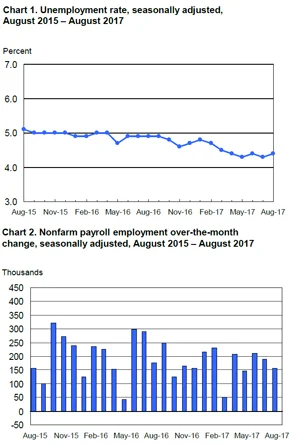
The August Employment Situation Summary released by the Bureau of Labor Statistics revealed a slowdown from 209,000 jobs added during July, to 156,000 nonfarm payroll positions created. According to The Washington Post, August's number notably undercut federal economists' expectation that about 200,000 jobs would be added to employers' payrolls. However, some private-sector analysts, like Indeed.com Chief Economist Jed Kolko, noted that this reduction in growth may be somewhat deceptive.

"Growth was slower in August, but that's because there were fewer gains in growing industries, not because we're seeing more losses in shrinking industries," Kolko told the Post in an interview. "We're actually at a point of unusual stability."

Additionally, although the unemployment rate rose to 4.4 percent from July's figure of 4.3 percent, the latter is a 16-year low, and because the Post reported that the uptick is considered small enough to remain within a reasonable margin of error, it is unlikely to worry public- and private-sector economists. CNBC noted that within a year, unemployment in the U.S. could easily fall below 4 percent.

On a sector-by-sector basis, manufacturing, construction, and professional and technical services saw the largest gains in August, with 36,000, 28,000 and 22,000 jobs added, respectively. The jumps in manufacturing and construction employment are particularly notable: Manufacturing grew by 155,000 roles since an all-time low employment total in November 2016. Meanwhile, construction remained relatively unchanged for the last five months, but received a notable boost from residential specialty contractors, whose businesses accounted for 12,000 of all positions added within the industry.

Healthcare employment did not grow by as much as it did in July - with more than 20,000 jobs added in August as opposed to July's 30,000-plus positions created. Nevertheless, it remains one of the most fastest-growing industries in the U.S., with 328,000 jobs created thus far in all of 2017.

Other industries including food services and drinking places, wholesale, trade, retail trade, transportation and warehousing, information, financial activities and government changed very little over the month.

Some metrics noted in the BLS's August report bear with them more uncertainty than the individual industry gains and essentially unchanged unemployment rate noted above. Average wages grew by 3 cents in the past month, a drop from the 9 cents seen in July. Also, the labor force participation rate for August 2017 held steady with July's 62.9 percent, a total that analysts generally view as sub-par if not necessarily dangerous.

The New York Times noted that economists also believe the Federal Reserve is likely to raise interest rates on federal loans before the year ends, likely in December. Though the Fed will meet in September, a rate hike isn't expected then. Wall Street traders, meanwhile, have reduced their own expectations of a rate increase from 50 percent to 30 percent. However, this does not necessarily indicate a negative perspective, as Torsten Slok, chief international economist at Deutsche Bank, pointed out.

"There's no sign of inflation, which keeps the Federal Reserve on hold in terms of interest rate hikes," Slok said to the Times, "and it suggests stocks should keep doing well."

The Trevi Group  |  www.TheTreviGroup.com 

Video: Employer attitudes on traditional degrees vs. online degrees

The working world has changed: No longer must job candidates have traditional four-year degrees to be considered for professional positions. Not only has online education become more popular, it has also become more sophisticated, with virtual learning experts developing immersive, dynamic online courses that are as valuable and informative as their on-campus counterparts.

Click to watch the video.

This shift has caused recruiters and hiring managers to take a new look at how they evaluate a job candidate's education and experience. While several years ago, an online degree may have been considered inferior to a traditional degree, that sentiment has significantly changed.

The MRINetwork 2017 Recruiter Sentiment Study found that more than 50 percent of recruiters and almost half of employers (43 percent) have no preference for candidates based on traditional versus alternative degrees. Another 13 percent of employers even prefer candidates with alternative degrees.

“To adapt to this changing landscape, employers should adjust their recruitment and interview processes to reflect the growing prevalence of online degrees,” says Sherry Engel, vice president of learning and talent development for MRINetwork. “This will ensure that they're not overlooking top talent for the positions they wish to fill.”

Engel recommends three best practices for what employers should consider when presented with a candidate who has an online degree:

1. Look for accreditation

With the sophistication of today's virtual learning software and models, online degrees can be just as prestigious as those earned from traditional universities. The online program might be offered by a brick-and-mortar institution, such as the University of Cincinnati or Harvard University, or it may come from an online-only institution. Either way, if the program is accredited, that’s a strong sign that it’s a high-quality, respected program. U.S. News & World Report recommends that employers look to see if the school is accredited by the Department of Education or the Council for Higher Education Accreditation. There are also smaller state or regional accreditations that can also attests to a program's substance.

To further evaluate a candidate’s education, ask what their program was like, why they enrolled in it and if it enriched their learning, taught valuable skills and prepared for their desired career.

2. Evaluate experience

Clearly, the degree itself is not the sole determining factor of whether a person has the skills and perspectives necessary for the job - experience plays a key part as well. In fact, in a survey of 50,000 employers conducted by The Chronicle of Higher Education, experience outweighed academic credentials among all industries, particularly in the science/technology, services/retail, and media/communications segments. Internships and employment during college rose to the top of the list as the most heavily weighted attributes considered by employers.

Employers also recognize that earning an online degree is not easy, especially when many who chose this form of education are juggling jobs or family obligations at the same time. Undoubtedly this experience has helped them gain technology skills, discipline and time management abilities that are applicable in nearly every profession. Use interviews to not only ask candidates about their work, volunteer and travel experiences, but also to inquire how the e-learning experience has enabled them to effectively manage a diverse array of tasks.

3. Focus on cultural fit

In addition to degrees and experience, cultural fit has become increasingly important in determining whether a person would be well-suited for a job. During the interview process, employers should try to get a sense of whether the candidate would mesh well with the mission, values and social climate of the company. For example, a candidate who strongly prefers to work alone with little oversight may not function well in a company where collaboration is prioritized. Asking behavior-based questions such as "What do you believe is the ideal work-life balance?" and "How do you deal with stressful situations at work?" can help you get a sense of a candidate's cultural fit.

“While the negative perception of alternative degrees has not been completely eradicated, online degrees no longer have the stigma that they once had among employers and recruiters,” concludes Engel. “This is encouraging because it means companies are rethinking how they hire, to ensure they're bringing on the best talent for each role.”

The Trevi Group  |  www.TheTreviGroup.com

BLS Employment Situation Report: July 2017

The July Employment Situation Report from the Bureau of Labor Statistics revealed a 0.1 percent decline in the U.S.'s unemployment rate - to 4.3 percent - and a gain of 209,000 jobs in total nonfarm payroll employment. According to Markets Insider, projections for the unemployment rate's small decline were spot-on, while economists' estimate of jobs that would be added in July - about 183,000 - missed the mark. Total jobs added suffered slightly compared to June, which saw 220,000 jobs added.

Some industries that saw an uptick in June, such as healthcare, experienced further improvement, while other sectors, such as food and professional and financial services, showed new increases that hadn't been seen the previous month. Also, the number of Americans classifiable as "long-term unemployed" remained static at around 1.8 million as it totaled the previous month, but that trend has seen gradual reduction for most of the year, per previous data releases by the BLS.

Both food service and professional and business services saw large job gains - of 53,000 and 49,000, respectively. Employment within the healthcare sector increased by 39,000, slightly more than in June, and notably outpacing the 2017 average of 24,000 new jobs in the field per month.

Mining, meanwhile, saw minor growth of only 1,000 jobs added, and several sectors, including construction, manufacturing, information, transportation, retail, financial services and government, saw no notable movement in either direction.

As noted in The New York Times, many economists consider a one-two punch of strong wage growth and a high rate of labor participation to be among the most reliable indicators of a strong economy. The participation rate earned significant attention in 2016 due to its decline, hitting lows not seen in the past several decades and fueling perception of economic downturn in spite of a fairly low unemployment rate - around 4.7 percent for much of last year. Any significant increase in this metric would thus engender increased confidence in the overall economy. The labor participation rate remained steadfast at 62.9 percent for the month - where it has remained for the greater part of 2017.

Average hourly earnings for all nonfarm employees rose 0.3 percent in July, slightly above the 0.2 percent wage growth experienced in June. Although not as high as many financial leaders might like, news of this growth and the generally strong jobs report caused increases in both stock futures and Treasury yields, according to CNBC.

Probability of an increase in Federal Reserve interest rates also strengthened, rising to 45 percent from the 41 percent noted as recently as Aug. 3, 2017. Overall, while the figures in the July BLS labor report did not show uniform improvements, its findings nonetheless constitute fairly positive news.

The Trevi Group | www.TheTreviGroup.com

As a member of MRINetwork, The Trevi Group is proud to have been ranked by Forbes as one of "America's Best Executive Search Firms" in 2017. Click here  to read what our top ten national ranking means for you.

As a member of MRINetwork, The Trevi Group is proud to have been ranked by Forbes as one of "America's Best Executive Search Firms" in 2017. Click here  to read what our top ten national ranking means for you.

Video: Working From Home - How Important Is It?

Recently, some large companies have curtailed the ability of their employees to work from home, now asking staff to work in corporate offices. These changes are focused on driving increased collaboration, creativity, mentoring and innovation, but may alienating top talent in the executive, managerial and professional labor market - a sector that has been candidate-driven and challenged by talent shortages for the last few years.


Click to watch the video.

This move comes at a time when many candidates express interest in working from home during the interview process. According to the MRINetwork 2017 Recruiter Sentiment Study, 68 percent of recruiters and 53 percent of employers state candidates ask for work from home options somewhat often to very often. Over half of candidates indicate that having a work from home option is somewhat to extremely important as they consider a new job.

“The U.S. unemployment rate is at a 16-year low, so failing to provide work from home options can put companies at a disadvantage in terms of attracting candidates,” observes Nancy Halverson, general manager, franchise operations for MRINetwork. “Technology has made communication, collaboration, security and other aspects of managing remote employee easier, allowing companies to implement this strategy as a way to attract and retain top talent.”

Halverson notes that work from home arrangements offer a number of significant advantages. “You can employ specialized people who live outside your geographic region, for example, and stay operational 24/7 with remote staff spread across different time zones,” she says. “You are also likely to maintain a more productive workforce and achieve higher long-term retention rates.”

The key to implementing a successful work from home program, Halverson advises, is the formation of a well-thought-out plan. “This necessitates drawing up formal guidelines and finding the right technological tools, as well as hiring the right people for the job of working remotely,” she says. “Once in place, the program requires oversight and tweaking to make it’s sustainable and successful.”

Halverson offers some useful guidelines for managing telecommuters on a day-to-day basis:

Set the right tone. Working from home has become more acceptable, and even desirable, to employers, so it should no longer be viewed as a reward or a privilege. Instead, you should treat it as a natural option for working. Set the expectation that remote working days are the same as in-office working days. Agree on goals and deadlines for particular tasks. Keep a close eye on how well the targets are being met and give feedback promptly and sensitively if things go wrong.

Determine metrics to measure progress. Monitoring and assessing the performance of people who work at home is perhaps the most significant managerial challenge. It can be helpful to measure their effectiveness in terms of their output rather than the hours they work to ensure that targets and deadlines are being met. You can set firm deliverables for work-from-home days (tangible pieces of work you can see have been completed), for example, or use time-tracking software.

Don’t forget about remote workers. Don’t just shoot off emails requesting updates on projects. Make informal calls to ask how things are going, allowing employees to express concerns and to feel appreciated and acknowledged. Take advantage of instant messaging and make sure that face-to-face meetings occur when possible or when needed. For times when it’s not possible to meet in person, video conferencing or Skype are great ways to provide a face-to face-element to brainstorming sessions or team meetings. These types of capabilities can make all the difference in helping remote employees see their co-workers occasionally, so that they feel connected and part of a community.

To further the feeling of community, treat remote workers the same as you do those in the office.  If it’s ugly sweater day during the holidays, encourage your remote person to do the same and send a picture or leverage that video technology again. If you let parents scoot out early to enjoy Halloween festivities with their little ones, allow the same privileges to remote workers.

Pay attention to warning signs. If a remote worker is missing deadlines or being asked to redo work, there could be a communication problem. Meet with the worker to discuss what communication channels could be used to correct the situation or if working from home is not the best option for the individual. Keep in mind that it doesn’t always work out for everyone.

Halverson believes that one of the biggest concerns of having virtual teams is that employees may feel their contributions aren't noticed or valued. "You don't want team members to feel as though they're just sending their work out into a vacuum," she cautions. "As a leader, you have to create a sense of involvement and inclusion so that your people don’t feel invisible.”

The Trevi Group | www.TheTreviGroup.com

Healthcare technology company to create more than 800 jobs in Palm Beach County

Healthcare technology company Modernizing Medicine will create more than 800 new jobs in Palm Beach County, Florida, by 2022, local station WPTV reported. 

The expansion will mark the largest jobs project in the county since 2009. Modernizing Medicine will receive a $6 million incentive package from the state if it adds 838 jobs in the next five years.

"We are extremely excited to expand our presence and create more jobs across a wide range of fields in South Florida," said CEO Dan Cane. 

The company has more than 550 employees currently, with 400 of them based in Boca Raton, the source noted. 

According to the Miami Herald, Modernizing Medicine produces more than $100 million in revenues each year and is one of the most rapidly growing tech companies in southern Florida. 

"There are not many companies growing as fast as Modernizing Medicine - in the world," said Gov. Rick Scott. 

The new jobs will largely be software development roles and will have an average annual salary of $55,000. 

The company is also expanding its headquarters, leasing space in the building that formerly served as the home of IBM in addition to its current main office at the Florida Atlantic University Research Park. 

The Trevi Group | www.TheTreviGroup.com

Silicon Valley impacts widespread job growth

A new report from CBRE shows that Silicon Valley is fueling job growth far beyond its borders. 

The Scoring Tech Talent Report found that many cities located far from California have seen large increases in their tech employment, Venture Beat detailed. 

Madison, Wisconsin, had the largest increase in "tech talent momentum" as determined by the report, and saw employment in the industry grow by 30.2 percent between 2015 and 2016. Madison was followed by Fort Lauderdale, Florida; Salt Lake City, Utah; Miami, Florida; and Kansas City, Missouri. 

"What we're seeing occurring now is the impact and influence that Bay Area tech companies are having in markets all across the country," said author of the report and Director of Research and Analysis at CBRE Colin Yasukochi in a statement. "Bay Area-based tech companies are opening offices and creating jobs in strategic markets like Pittsburgh and Detroit for example, as they work in partnership with universities and automotive companies on integrating their technologies into self-driving cars."

Rural communities may stand to benefit from the employment and economic impacts of Silicon Valley with the construction of a new rail line between Silicon Valley and San Jose, California, Mercury News reported. 

The train would be the first high-speed rail line in the U.S., and is slated to be completed in 2025. 

The Trevi Group |  www.TheTreviGroup.com

Employment Summary for June 2017

The June Employment Situation released by the Bureau of Labor Statistics showed that the U.S. economy added 222,000 jobs. This far exceeded analysts’ expectations of just over 170,000 jobs. The current unemployment rate is 4.4 percent.

Healthcare added 37,000 jobs, with 25,000 of these roles increasing in ambulatory healthcare services, and 12,000 in hospitals. Despite continued job growth, the Bureau of Labor Statistics noted that the average number of monthly jobs added in healthcare in 2017 is 24,000 vs. an average of 32,000 jobs per month in 2016.

Professional and business services continued its growth trend, adding 35,000 jobs in June. Food services and drinking places also saw continued growth, adding 29,000 jobs throughout the month.

Employment in financial activities rose by 17,000 positions.

Industries such as construction, manufacturing, wholesale and retail trade, information and government were relatively unchanged throughout the month.

The New York Times reported that June continued building on the growth of previous months. The average number of jobs added to the economy from April to June was 194,000. For 2017, the average monthly job growth is at 180,000, a slight decline from the average 2016 monthly growth of 187,000 jobs.

The source also noted that analysts anticipate the unemployment rate will continue to stay down, even when taking a closer look at the number of discouraged workers and “underemployed” workers, or those who are working part-time but would prefer full-time roles. In June, the unemployment rate that accounted for these workers was at 8.6 percent, a slight uptick from the previous month. Yet, this number is also a full point lower than it was at this time last year.

In the midst of this good news, analysts continue to watch the slow wage growth.

“The wage numbers are certainly weaker than expected, so it keeps alive that whole debate about the relationship between slack and inflation and how far the Federal Reserve should allow the unemployment rate to fall,” Jim O’Sullivan, the chief U.S. economist for High Frequency Economics, told the Times.

Despite these concerns, the hourly wage increased by 2.5 percent from the same time one year ago. The current hourly wage is $26.25 for private non-farm payroll.

The Trevi Group  |  www.TheTreviGroup.com

The Trevi Group, as part of MRINetwork, is Ranked Among Top Executive Recruiting Firms by Forbes.com

Forbes.com, a leading source of reliable news and analysis, recently published its list of the best executive recruiting firms in the U.S. Thousands of recruiters, candidates who have worked with recruiters, and HR managers recommended the recruiting firms they perceive to be the best. The Trevi Group is part of MRINetwork, one of the largest search and recruitment organizations in the world, ranked among the top ten of this prestigious group.  

As an affiliate of MRINetwork, we know firsthand what it takes to earn that ranking. There are no simple formulas. It takes focused research, systematic search, determination and hard work. We take the time to learn your business, and we approach each assignment in partnership with you. We succeed because we are innovative, caring, tenacious and discreet.

It just makes sense to use a recruitment firm; when you need a proven-performer with a skill set that’s hard to find; when you need multiple people at once; when you’re backlogged and need people right now; or when you need multiple people for a short-term project. Recruiters who specialize in your industry build relationships with you to understand your requirements and work quickly when you are most in need. They have the connections and talent pipelines to fill hard-to-find skill sets, and they know how to present your opportunity in a way that motivates candidates to join your team.

We’re proud of our place in the Forbes’ rankings, and you can be confident that you’ll be working with one of the best recruiting firms in the U.S.

The Trevi Group  |  www.TheTreviGroup.com

The Recruiter's View: Top Hiring Insights of 2017

According to a June New York Times article, “We may be closer to full employment than it seemed.” Based on the May jobs report, the source asserts the possibility that this is as good as it will get for the United States labor market. Why? Slowed job growth with 121,000 new positions as the three-month average, and an all-time low of 4.3 percent for the unemployment rate - not because of more people finding work - but because of modest wage increases and a labor force that has been shrinking for the last few years.

Click to watch the video.

This dynamic is particularly apparent in the executive, managerial and professional job market where many companies are focused on expanding, but are finding it difficult to locate enough skilled talent. In this sector, which has been candidate-driven for several years, the lack of skilled talent is further complicated by top candidates who feel free to reject job offers and accepting offers from other companies. So as a hiring authority, what can you do to improve your odds of bringing in the talent that you seek?

The 2017 Recruiter Sentiment Study conducted by MRINetwork, reveals that the inability to find quality talent coincides with lengthy hiring practices, lower than expected compensation, and an employer sentiment that candidates should be honored to be considered for their job opportunities. Retention is also challenging, as high performers recognize more jobs are available and feel more confident about pursuing them.

Based on the Study findings, the following are the top hiring insights for employers to know:

Insight #1: It really is a candidate-driven market.

MRINetwork recruiters have been observing the shift to a candidate-driven market over the last five years and the according to the survey, 90 percent of recruiters still feel the professional labor market is candidate-driven in most industry sectors. By contrast, 47 percent of employers believe companies have the upper hand. The reality is the best candidates have other job options, so your value proposition must clearly articulate how coming on board would benefit their career. Assuming that candidates should feel lucky to be invited for an interview with your company is one of the biggest mistakes that can be made when trying to attract top talent.

Insight #2: Compensation has become the top deciding factor for high performers who are looking to make a job move.

Recruiters, employers and candidates agree that advancement opportunities and better compensation packages are the most important factors to candidates looking for a job. Over 50 percent of candidates selected competitive compensation packages most often, followed by advancement opportunities, suggesting that compensation is the deciding factor when considering a new job. Across all respondents, compensation was also one of the primary reasons an offer was rejected, along with the candidate accepting another offer. Ultimately, compensation needs to be competitive enough to convince high performers to leave their current employers.

Insight #3: Rejected job offers matter in a talent short economy.

Almost half of surveyed employers said offer rejection percentages were between 1 – 10 percent. While this may seem like a small amount, every bit of lost talent matters when there is a shortage of qualified candidates in many industries. Compensation is not the only reason for offer rejections; frequently it is the interview process itself. It’s critical to provide a streamlined and positive interview process that keeps applicants informed of where they stand every step of the way. Most importantly, everyone on the interviewing team should be providing consistent messaging about the role, and clearly articulating why your company culture and values make it an enviable place to work.

Insight #4:  Workplace expectations have changed. 

Today’s top performers want more out of life than the standard 9-5, in-office work scenario. Fifty-five percent of surveyed candidates said work-from-home options are somewhat to extremely important to them.  Additionally, an “emphasis on work-life balance” was the second most selected attribute by candidates who are consider a job move this year. While the tendency may be to think that candidates want to work less, or that working from home will decrease productivity, top talent want to work more efficiently, any time, and from anywhere. Providing this flexibility is not only attractive to prospective hires, but also creates the potential for happier, engaged employees who feel their work life does not overshadow personal interests and obligations.   

Insight #5: Most companies aren’t prepared for upcoming surge in Baby Boomers retirements.

When asked to describe the upcoming onset of large-scale Baby Boomer retirements, employers and recruiters agreed that most businesses are not prepared for the workforce changes involved with preparing for baby boomer departures. Employers also feel that programs will need to be developed to retain Baby Boomers to alleviate some of this pressure. Organizations that are able to prioritize succession planning and career-pathing now by making it part of their company culture will be better able to respond to baby boomer retirements.

When you consider these 5 hiring insights, it’s clear how they may be impacting your ability to attract top talent in an already tight candidate market. The hiring landscape and candidate expectations have changed. Companies that want to attract and retain the best talent, will need to revisit their interviewing and talent management approaches, to position themselves as a great place to work.

To view the complete Study and a short video recap of these hiring insights that can be easily distributed to others in your organization responsible for hiring, visit MRINetwork.com/Recruiter-Sentiment-Study.

The Trevi Group  |  www.TheTreviGroup.com