Employment Summary for June 2017

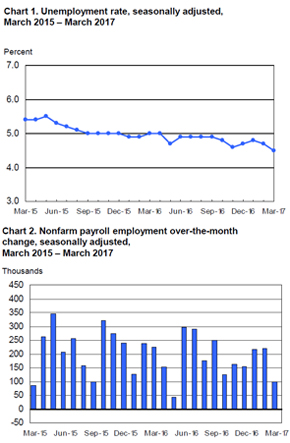
The June Employment Situation released by the Bureau of Labor Statistics showed that the U.S. economy added 222,000 jobs. This far exceeded analysts’ expectations of just over 170,000 jobs. The current unemployment rate is 4.4 percent.

Healthcare added 37,000 jobs, with 25,000 of these roles increasing in ambulatory healthcare services, and 12,000 in hospitals. Despite continued job growth, the Bureau of Labor Statistics noted that the average number of monthly jobs added in healthcare in 2017 is 24,000 vs. an average of 32,000 jobs per month in 2016.

Professional and business services continued its growth trend, adding 35,000 jobs in June. Food services and drinking places also saw continued growth, adding 29,000 jobs throughout the month.

Employment in financial activities rose by 17,000 positions.

Industries such as construction, manufacturing, wholesale and retail trade, information and government were relatively unchanged throughout the month.

The New York Times reported that June continued building on the growth of previous months. The average number of jobs added to the economy from April to June was 194,000. For 2017, the average monthly job growth is at 180,000, a slight decline from the average 2016 monthly growth of 187,000 jobs.

The source also noted that analysts anticipate the unemployment rate will continue to stay down, even when taking a closer look at the number of discouraged workers and “underemployed” workers, or those who are working part-time but would prefer full-time roles. In June, the unemployment rate that accounted for these workers was at 8.6 percent, a slight uptick from the previous month. Yet, this number is also a full point lower than it was at this time last year.

In the midst of this good news, analysts continue to watch the slow wage growth.

“The wage numbers are certainly weaker than expected, so it keeps alive that whole debate about the relationship between slack and inflation and how far the Federal Reserve should allow the unemployment rate to fall,” Jim O’Sullivan, the chief U.S. economist for High Frequency Economics, told the Times.

Despite these concerns, the hourly wage increased by 2.5 percent from the same time one year ago. The current hourly wage is $26.25 for private non-farm payroll.

The Trevi Group  |  www.TheTreviGroup.com

The Trevi Group, as part of MRINetwork, is Ranked Among Top Executive Recruiting Firms by Forbes.com

Forbes.com, a leading source of reliable news and analysis, recently published its list of the best executive recruiting firms in the U.S. Thousands of recruiters, candidates who have worked with recruiters, and HR managers recommended the recruiting firms they perceive to be the best. The Trevi Group is part of MRINetwork, one of the largest search and recruitment organizations in the world, ranked among the top ten of this prestigious group.  

As an affiliate of MRINetwork, we know firsthand what it takes to earn that ranking. There are no simple formulas. It takes focused research, systematic search, determination and hard work. We take the time to learn your business, and we approach each assignment in partnership with you. We succeed because we are innovative, caring, tenacious and discreet.

It just makes sense to use a recruitment firm; when you need a proven-performer with a skill set that’s hard to find; when you need multiple people at once; when you’re backlogged and need people right now; or when you need multiple people for a short-term project. Recruiters who specialize in your industry build relationships with you to understand your requirements and work quickly when you are most in need. They have the connections and talent pipelines to fill hard-to-find skill sets, and they know how to present your opportunity in a way that motivates candidates to join your team.

We’re proud of our place in the Forbes’ rankings, and you can be confident that you’ll be working with one of the best recruiting firms in the U.S.

The Trevi Group  |  www.TheTreviGroup.com

The Recruiter's View: Top Hiring Insights of 2017

According to a June New York Times article, “We may be closer to full employment than it seemed.” Based on the May jobs report, the source asserts the possibility that this is as good as it will get for the United States labor market. Why? Slowed job growth with 121,000 new positions as the three-month average, and an all-time low of 4.3 percent for the unemployment rate - not because of more people finding work - but because of modest wage increases and a labor force that has been shrinking for the last few years.

Click to watch the video.

This dynamic is particularly apparent in the executive, managerial and professional job market where many companies are focused on expanding, but are finding it difficult to locate enough skilled talent. In this sector, which has been candidate-driven for several years, the lack of skilled talent is further complicated by top candidates who feel free to reject job offers and accepting offers from other companies. So as a hiring authority, what can you do to improve your odds of bringing in the talent that you seek?

The 2017 Recruiter Sentiment Study conducted by MRINetwork, reveals that the inability to find quality talent coincides with lengthy hiring practices, lower than expected compensation, and an employer sentiment that candidates should be honored to be considered for their job opportunities. Retention is also challenging, as high performers recognize more jobs are available and feel more confident about pursuing them.

Based on the Study findings, the following are the top hiring insights for employers to know:

Insight #1: It really is a candidate-driven market.

MRINetwork recruiters have been observing the shift to a candidate-driven market over the last five years and the according to the survey, 90 percent of recruiters still feel the professional labor market is candidate-driven in most industry sectors. By contrast, 47 percent of employers believe companies have the upper hand. The reality is the best candidates have other job options, so your value proposition must clearly articulate how coming on board would benefit their career. Assuming that candidates should feel lucky to be invited for an interview with your company is one of the biggest mistakes that can be made when trying to attract top talent.

Insight #2: Compensation has become the top deciding factor for high performers who are looking to make a job move.

Recruiters, employers and candidates agree that advancement opportunities and better compensation packages are the most important factors to candidates looking for a job. Over 50 percent of candidates selected competitive compensation packages most often, followed by advancement opportunities, suggesting that compensation is the deciding factor when considering a new job. Across all respondents, compensation was also one of the primary reasons an offer was rejected, along with the candidate accepting another offer. Ultimately, compensation needs to be competitive enough to convince high performers to leave their current employers.

Insight #3: Rejected job offers matter in a talent short economy.

Almost half of surveyed employers said offer rejection percentages were between 1 – 10 percent. While this may seem like a small amount, every bit of lost talent matters when there is a shortage of qualified candidates in many industries. Compensation is not the only reason for offer rejections; frequently it is the interview process itself. It’s critical to provide a streamlined and positive interview process that keeps applicants informed of where they stand every step of the way. Most importantly, everyone on the interviewing team should be providing consistent messaging about the role, and clearly articulating why your company culture and values make it an enviable place to work.

Insight #4:  Workplace expectations have changed. 

Today’s top performers want more out of life than the standard 9-5, in-office work scenario. Fifty-five percent of surveyed candidates said work-from-home options are somewhat to extremely important to them.  Additionally, an “emphasis on work-life balance” was the second most selected attribute by candidates who are consider a job move this year. While the tendency may be to think that candidates want to work less, or that working from home will decrease productivity, top talent want to work more efficiently, any time, and from anywhere. Providing this flexibility is not only attractive to prospective hires, but also creates the potential for happier, engaged employees who feel their work life does not overshadow personal interests and obligations.   

Insight #5: Most companies aren’t prepared for upcoming surge in Baby Boomers retirements.

When asked to describe the upcoming onset of large-scale Baby Boomer retirements, employers and recruiters agreed that most businesses are not prepared for the workforce changes involved with preparing for baby boomer departures. Employers also feel that programs will need to be developed to retain Baby Boomers to alleviate some of this pressure. Organizations that are able to prioritize succession planning and career-pathing now by making it part of their company culture will be better able to respond to baby boomer retirements.

When you consider these 5 hiring insights, it’s clear how they may be impacting your ability to attract top talent in an already tight candidate market. The hiring landscape and candidate expectations have changed. Companies that want to attract and retain the best talent, will need to revisit their interviewing and talent management approaches, to position themselves as a great place to work.

To view the complete Study and a short video recap of these hiring insights that can be easily distributed to others in your organization responsible for hiring, visit MRINetwork.com/Recruiter-Sentiment-Study.

The Trevi Group  |  www.TheTreviGroup.com

Nashville named best city for professional and business services jobs

Nashville, Tennessee, topped Forbes' list of the best cities in the country for professional and business services jobs. 

The publication analyzed labor market data as well as job growth trends to determine its ranking. 

Nashville had the highest growth rate of any city in the country in the professional and business services jobs sector, according to Forbes. It has added 160,300 positions since 2011, representing a 42.6 percent increase. 

The source cited "low taxes and a pro-business regulatory environment" as two of the top factors driving job growth in the city. 

The Nashville city government and Chamber of Commerce have implemented initiatives to support business development and job opportunities in the city, the local NewsChannel5 Network reported. 

"We've very focused on long-term planning, not just planning for tomorrow," said Chief Development Officer for the Nashville Area Chamber of Commerce Courtney Ross in an interview with the source. "Now we're in the process of planning for the next five years, the next 10 years."

The No. 2 city in Forbes' ranking was Kansas City, Missouri, which has seen 28.4 percent growth in professional and business services jobs since 2011. 

Nashville, Tennessee, topped Forbes' list of the best cities in the country for professional and business services jobs.  The publication analyzed labor market data as well as job growth trends to determine its ranking.  Nashville had the highest growth rate of any city in the country in the professional and business services jobs sector, according to Forbes. It has added 160,300 positions since 2011, representing a 42.6 percent increase.  The source cited "low taxes and a pro-business regulatory environment" as two of the top factors driving job growth in the city.  The Nashville city government and Chamber of Commerce have implemented initiatives to support business development and job opportunities in the city, the local NewsChannel5 Network reported.  "We've very focused on long-term planning, not just planning for tomorrow," said Chief Development Officer for the Nashville Area Chamber of Commerce Courtney Ross in an interview with the source. "Now we're in the process of planning for the next five years, the next 10 years." The No. 2 city in Forbes' ranking was Kansas City, Missouri, which has seen 28.4 percent growth in professional and business services jobs since 2011. 

The Trevi Group  |  www.TheTreviGroup.com

Amazon Web Services delivers strong Q1 results

Consumers interact with Amazon daily - sometimes even without their knowledge. Amazon Web Services works on the backend of many websites, connecting sites around the world. Since being introduced in 2002, AWS is now responsible for 10 percent of the company's operating income - and powers websites like Netflix, The Guardian reported.

AWS operating income grew by nearly 50 percent from the same time last year, from January to March 31, Geekwire noted. It also saw a 42 percent growth spurt from the previous quarter. Can Amazon continue to grow AWS? And what does it mean for the tech industry?

As consumers continue to integrate IoT devices such as Alexa in their homes and utilize the ample amount of storage in the cloud, there may be no stopping the tech giant. Wa-Mart is one company that, after hearing news of Amazon's purchase of Whole Foods, is telling its tech vendors to work with another provider other than AWS. Microsoft Azure and Google Cloud Compute stand as the two biggest competitors in the market.

The Trevi Group | www.TheTreviGroup.com

BLS Employment Situation Report: May 2017

The U.S. added 138,000 jobs in May as the unemployment rate edged down from 4.4 percent in April to settle at 4.3 percent, according to data released by the Bureau of Labor Statistics.

The rate is currently at its lowest level in 16 years, Bloomberg noted. However, the number of jobs gained fell short of economists' expectations, which predicted the addition of 182,000 jobs.

"Job growth is a little disappointing, but enough to continue tightening the labor market," said JPMorgan Chase & Co. Chief U.S. Economist Michael Feroli, in an interview with the source. "This doesn't change the overall story of an economy that generally seems to be growing above trend and reducing slack."

Since January, the number of unemployed has dropped by nearly 780,000, and the unemployment has fallen 0.5 percentage point.

Both the labor force participation rate and the employment-population ratio decreased slightly in May. Over the year, the number of discouraged workers declined by 183,000.

Total nonfarm payroll employment grew by 138,000 during the month. Average hourly earnings for private nonfarm payroll employees increased by 4 cents to reach $26.22. Average hourly earnings for private-sector production and nonsupervisory employees were $22.00, an increase of 3 cents.

Sector-wise, professional and business services added the most jobs in May, gaining 38,000 positions. Job gains in this segment have averaged 46,000 per month this year.

Food services and drinking places employment increased by 30,000 jobs.

Healthcare added 24,000 positions, with 13,000 in ambulatory healthcare services and 7,000 at hospitals.

Mining employment increased by 7,000, bringing total job gains in the industry since its October 2016 low to 47,000.

There was little employment change in construction, wholesale trade, transportation and warehousing, information and construction.

According to Bloomberg, the tightening U.S. labor market is expected to push the Federal Reserve to increase interest rates at their meeting June 13-14.

The Trevi Group  |  www.TheTreviGroup.com 

Video: Retain Your Clients By Retaining Your Employees

Suppose you have a client who deals with a specific representative within your organization on a regular basis. Then that client starts to see multiple employees being funneled through that position. Every time the client contacts you, they’re dealing with a new person. What does this say to your client about your company? Countless negative things can be inferred from a high turnover rate, which often results in the loss of your clients to another company they perceive as better managed and more reliable.

Click to watch the video.

“Most clients regard a revolving door of employee contacts as annoying at best, and a deal breaker at worst,” says Alicia Sinay, senior franchise development manager for MRINetwork. “Businesses are increasingly relying on relationships, and it’s much easier to maintain the relationships you’ve cultivated with your clients when you don’t have to brief a new person on your business goals every six months, or repeat work that has already been completed as a new employee is being brought up to speed.”

While losing clients means a loss of income for your company, a high turnover rate has the capacity to be even more far-reaching and damaging in today’s candidate-driven marketplace. That’s why your strategy to retain clients should include retaining the employees who serve those clients.

If your goal is to foster employees who are satisfied with their position, you should be aware they expect the following:

  • Ability to use their talent and skills in the workplace. Many of your people could contribute far more than they currently do, if their managers take the time to tap into their skills, talent and experience. Whenever possible, allow them to focus their time and energy on projects they enjoy. Show employees you trust them by giving them responsibilities that provide the opportunity to demonstrate their capabilities in other areas. Your business may benefit from applying their knowledge and experience to expanded job duties.
     
  • Frequent opportunities to learn and grow in their careers, knowledge and skill. Without the opportunity to work on new projects, serve on challenging and significant teams, and attend seminars and classes, they will stagnate - and ultimately leave your company. Career pathing is a great way for employees and managers to map out an upward mobility track, while placing the responsibility on the employee to achieve certain goals in order to receive a promotion, salary increase or both.
     
  • Awards and Recognition. A simple thank you or a congratulatory award often goes a long way in recognizing a job well done. That said, monetary rewards and bonuses, tied to accomplishments and achievements, can be even more motivating.
     
  • Communication with their managers. In addition to exit interviews when employees are leaving, routinely ask your employees why they stay. Ask questions such as: Why did you decide to accept a role within the organization? What are your nonnegotiable issues? What would you change or improve? Then use that information to strengthen your employee retention strategies.

Putting these effective retention strategies in place is key to retaining employees and better serving your clients. “Create an environment that stimulates employee satisfaction by incorporating motivation-building practices into your corporate culture,” advises Sinay. “Listen to your employees, respect their opinions, and be available to help with everything from ideas and concerns to assisting them with their career advancement.”

Employees need to feel valued and appreciated, be given feedback, provided with growth opportunities and work-life balance options, and have trust and confidence in their leaders. In this kind of environment, employees deliver higher-than-expected levels of service to each and every client. They take pride in their company and in their work, resulting in retention both of your workforce and your client base.

The Trevi Group | www.TheTreviGroup.com 

Demand grows for data engineers

As the use of big data expands, the demand is growing for professionals who can design the systems and network architecture that effectively gather, store and present this data. 

The value of big data is in the strategic insights it offers, which are uncovered by data scientists and analysts. However, it turns out that data engineers may be the missing element that makes company's big data initiatives successful.

Brian Hills, head of data at Innovation Centre noted in an article for Data Economy, "One of the key learnings from the past few years is that success with data cannot be dependent on data scientists alone ... Using only this approach within a business creates a cottage industry that limits ability to scale and generates a significant number of risks." 

He writes that data engineers also need to be part of the team, as they build the systems that enable data to be analyzed. There is growing demand for these professionals, with Stitch Data finding just 6,500 people with data engineer titles on LinkedIn and 6,600 job openings for data engineers in San Francisco alone. 

Some 42 percent of data engineers have a background in software engineering, research by Stitch Data showed, while the top five data engineering skills are SQL, Java, Python, Hadoop and Linux. 

The Trevi Group | www.TheTreviGroup.com

BLS Employment Situation Report: April 2017

The U.S. job market bounced back in April, adding 211,000 nonfarm payroll jobs during the month, according to data released today by the U.S. Bureau of Labor Statistics.

The gains exceeded Bloomberg economists' prediction of 190,000 jobs added, and followed a weaker-than-expected March that saw 79,000 jobs added, revised down from the previously reported 98,000 jobs.

The unemployment rate fell from 4.5 percent in March to 4.4 percent in April, which is the lowest rate since May 2007, Reuters reported. The unemployment rate has dropped by 0.6 percentage point over the year. The labor force participation rate was relatively unchanged in April at 62.9 percent.

Industry-wise in April:

  • Leisure and hospitality added the most jobs, gaining 55,000 new positions. Employment grew in the food services and drinking places sector by 26,000.
     
  • Professional and business services followed, adding 39,000 positions. Over the year, employment in the industry has expanded by 612,000 jobs.
     
  • Healthcare and social assistance gained 37,000 positions, on par with its monthly average so far for 2017.
     
  • Financial activities employment grew by 19,000, with the gains largely driven by insurance activity.
     
  • Mining added 9,000 jobs.

Average hourly earnings for all private nonfarm payroll employees increased by 7 cents in April to reach $26.19. Last week, a government report was released that showed private sector wages had their biggest growth in a decade in the first quarter of 2017, according to Reuters.

With the strengthening employment figures, the Federal Reserve is likely to raise interest rates later this year.

"Labor market conditions remain robust and continue to tighten," said Chief Financial Economist Ward McCarthy of Jefferies LLC in New York, according to Bloomberg. "This data will keep the Fed on track for a preferred 2017 normalization timeline of rate hikes in June and September and the first step toward balance-sheet normalization in December."

Bloomberg also noted that income gains, particularly in real estate prices and stock, have contributed to a more positive consumer outlook.

The Trevi Group | www.TheTreviGroup.com